
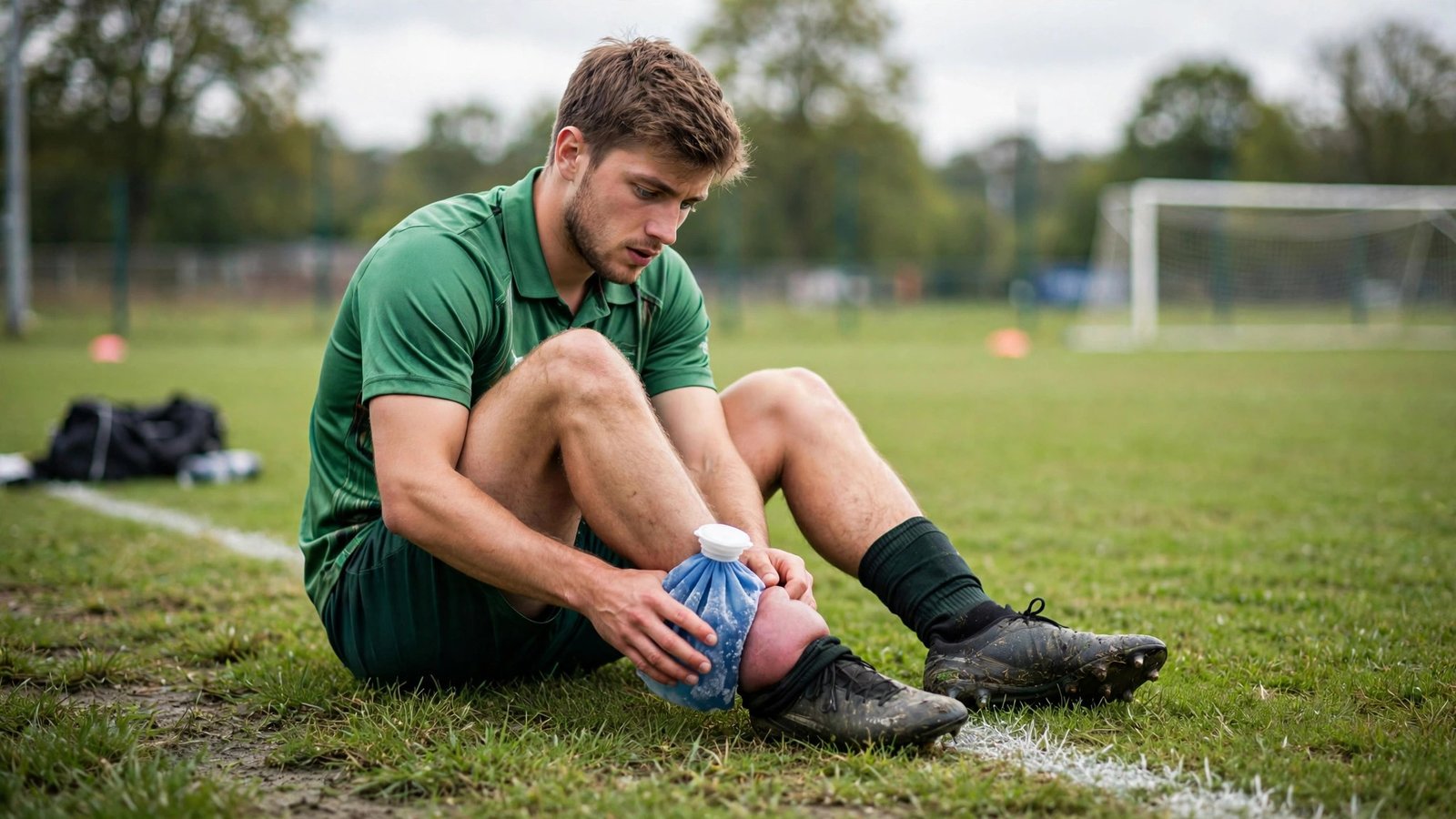
You rolled your ankle in the 70th minute, heard a pop, and finished the game on adrenaline — and now it is the size of a tennis ball and you are wondering whether you actually need a doctor or just ice and a good attitude. Twisted ankles are the most common soccer injury by a wide margin, and the vast majority are simple sprains that heal with home care. But a meaningful minority are fractures, high ankle sprains, or torn ligaments that get worse when ignored, and the difference between “walk it off” and “get an X-ray” is not always obvious in the first hour. Here is how to read your own ankle like a sports medicine clinician would, so you neither waste a Saturday in urgent care nor limp around on a fracture for three weeks.
First, Understand What Actually Happened in There
Most soccer ankle twists are inversion sprains: your foot rolls inward, stretching or tearing the ligaments on the outside of the ankle, especially the anterior talofibular ligament. These are graded 1 through 3 — a mild stretch, a partial tear, or a complete rupture. Far less common but more serious are high ankle sprains (damage to the ligaments connecting the tibia and fibula, usually from the foot being forced outward) and fractures, particularly of the fibula or the talus. High ankle sprains heal much more slowly than lateral sprains and are the ones most often misdiagnosed as “just a sprain.” Knowing this anatomy matters because each injury has its own red flags, and the care for a fracture is nothing like the care for a Grade 1 sprain.
Use the Ottawa Ankle Rules at Home
Emergency departments use a validated checklist called the Ottawa Ankle Rules to decide who needs an X-ray, and you can apply the core logic yourself. Get imaging if any of these are true: you cannot bear weight — meaning you cannot take four steps, even limping — both immediately after the injury and when you check again; there is bone tenderness at the back edge or tip of either ankle bone (the malleoli); or there is tenderness along the midfoot or an inability to bear weight pointing to a foot fracture. These rules catch nearly all fractures while sparing most sprains an unnecessary X-ray. They are not a diagnosis, but they are the best home triage tool sports medicine has.
Red Flags That Mean “Go Today, Not Tomorrow”
Beyond the Ottawa criteria, certain signs should send you to urgent care or your doctor the same day. Visible deformity — the ankle looks crooked, displaced, or angulated — is an obvious one. So is numbness, tingling, or a foot that turns pale or feels cold, which can signal circulation or nerve compromise. Rapid, severe swelling within minutes, a loud pop followed by immediate inability to stand, or pain directly over the bony prominences rather than the soft tissue all raise the fracture odds. Pain above the ankle joint itself, especially when you squeeze the calf, hints at a high ankle sprain, which needs professional evaluation even though it is not a fracture. And if the ankle gives way repeatedly over the following days — the joint feels unstable, like it might buckle — the ligaments may be significantly torn and need a clinician’s assessment, possibly an MRI.
What Proper Home Care Looks Like for a Simple Sprain
If you can bear weight, the pain is over soft tissue rather than bone, and there is no deformity, you are likely dealing with a Grade 1 or 2 sprain that home care handles well. The modern protocol has moved past old-school total rest: protect the ankle for a day or two, but start gentle movement early, because controlled motion reduces stiffness and speeds ligament healing. Ice for 15 to 20 minutes a few times a day during the first 48 hours, compress with an elastic bandage (snug, not numb-making), and elevate above heart level as often as you can. Over-the-counter anti-inflammatories help pain, though some sports medicine research suggests not overdoing them in the first day since inflammation is part of healing. Begin gentle range-of-motion work within a couple of days, then progress to single-leg balance exercises — the best defense against re-spraining. The American Orthopaedic Foot & Ankle Society’s patient resources detail how proprioception retraining prevents chronic instability.
When “Wait and See” Stops Being Reasonable
Here is the timeline that should trigger a visit even if the first day seemed fine. If you cannot walk normally within three to four days, get evaluated — a simple sprain should be improving by then. If swelling has not meaningfully decreased after a week, something beyond a mild sprain is likely. If the same ankle has been sprained before and this episode feels worse or the joint feels loose, chronic instability may be developing, and a physical therapist can fix what rest cannot. And if pain persists beyond two to three weeks despite proper care, ask about imaging beyond an X-ray: stress fractures and cartilage injuries of the talus hide from X-rays and explain the classic “sprain that never got better.” Trust the trend more than any single day — steady improvement means you are on track; a plateau or regression means you need eyes on it.
Can you take four steps on it? Is the pain over soft tissue rather than bone? Then it’s probably a routine sprain that home care will handle. Can’t bear weight, see deformity, feel numbness, or still can’t walk normally after a few days — that’s your signal to get professional evaluation without delay.
What the Doctor Will Actually Do
Knowing the process removes the fear of going. The clinician will take a history (how the foot twisted, what you heard and felt), palpate the specific ligaments and bones, and test stability by gently stressing the joint. If the Ottawa criteria or exam suggest it, you will get weight-bearing X-rays. For suspected high ankle sprains or persistent pain with clean X-rays, an MRI may follow. Treatment for confirmed simple sprains is usually a brace or walking boot for a week or two, a referral to physical therapy for balance and strengthening work, and a graded return-to-play plan — typically two to six weeks depending on severity. Fractures may mean a boot and crutches for six weeks or, for displaced fractures, surgery. The key point: early, accurate diagnosis shortens total recovery time. The players who miss a whole season are usually the ones who tried to tough out a serious injury, not the ones who got checked promptly.
Conclusion
Most twisted soccer ankles are routine sprains that respond beautifully to smart home care: protect briefly, ice and elevate, move early, and rebuild balance. But your ankle gives you clear signals when the injury is more than that — inability to bear weight, bone tenderness, deformity, numbness, or pain that refuses the normal healing timeline. Respect those signals and get evaluated; sports medicine exists precisely for this call. For more injury-smart guidance, explore our sports coverage, meet the team behind it, or send us your sports health question directly.
Frequently Asked Questions
Can I play through a twisted ankle if the pain isn’t that bad?
Finishing a game on adrenaline is common, but playing on a freshly sprained ankle in the following days risks turning a Grade 1 sprain into a Grade 2 or 3, and a small fracture into a displaced one. Sit out until you can walk, jog, and cut without pain or limping — usually days for mild sprains, weeks for worse ones.
Should I get an X-ray for every twisted ankle?
No. The Ottawa Ankle Rules exist precisely to avoid unnecessary X-rays: if you can bear weight and there is no bone tenderness, an X-ray is very unlikely to change anything. Get imaging when you cannot take four steps, have tenderness over the ankle bones, or show any red-flag signs.
How long does a typical soccer ankle sprain take to heal?
Grade 1 sprains often resolve in one to two weeks, Grade 2 in three to six weeks, and Grade 3 or high ankle sprains in eight to twelve weeks or more. Returning before the ankle is stable is the main reason sprains become chronic — rehab, especially balance training, matters as much as rest.
Is a walking boot overkill for a sprain?
For mild sprains, yes — a lace-up brace and early movement are better. Boots are appropriate for Grade 3 sprains, suspected fractures, or high ankle sprains where immobilization protects healing ligaments. A clinician can tell you which category you are in.
Why does my ankle keep rolling after the first sprain?
Repeated rolling usually means the ligaments healed in a lengthened position or your proprioception — the ankle’s position sense — never recovered. This chronic instability responds well to physical therapy focused on balance and peroneal strengthening. An ankle brace during play is a smart bridge while you rehab.
Leave a Reply