
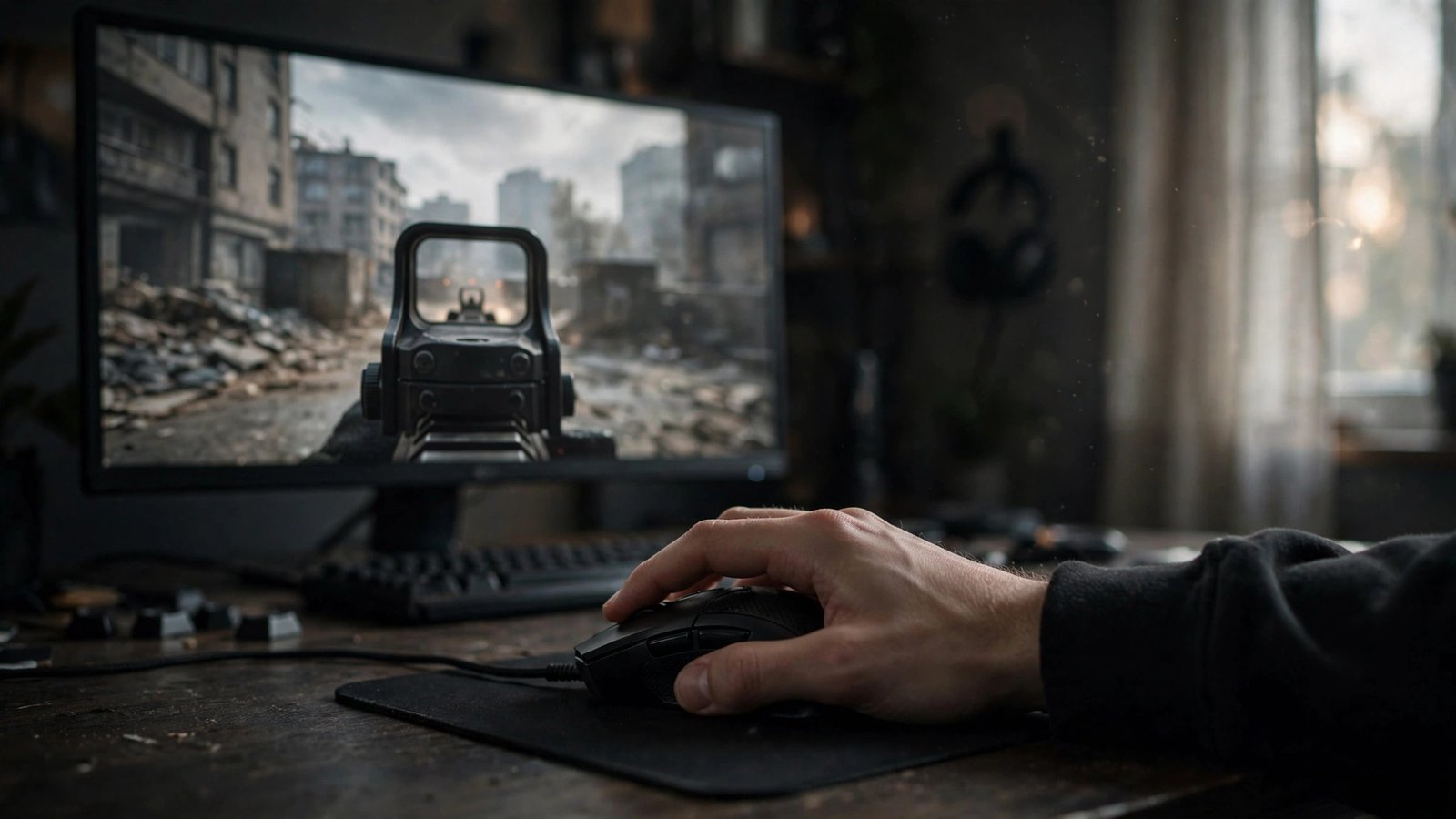
Every great FPS player was once the person getting destroyed in every lobby, convinced that good aim was something you were born with. It is not. Aim is a trainable skill with trainable components — mouse control, crosshair placement, target tracking, and game sense — and beginners improve fastest when they stop playing on autopilot and train deliberately. You do not need a $200 mouse or a thousand hours. You need the right sensitivity, a short daily routine, and the patience to build fundamentals before chasing highlights. Here is the beginner’s path that actually works.
Fix Your Sensitivity Before Anything Else
Most beginners play on sensitivity that is far too high, usually the default. High sensitivity feels responsive but makes precise adjustments impossible — your crosshair skips past heads instead of landing on them. Start lower than feels natural: a common baseline is around 30 to 40 centimeters of mouse movement for a full 360-degree turn in-game. Set your Windows pointer speed to the middle notch (6/11) with “Enhance pointer precision” off, and disable mouse acceleration everywhere — acceleration makes the same hand movement produce different results depending on speed, which destroys muscle memory. Give any new sensitivity at least a week before judging it; the first two days always feel wrong. The sensitivity guides at Mouse-Sensitivity.com help translate settings between games so your aim transfers.
Crosshair Placement: The Free Skill
The single highest-value habit for beginners costs zero practice time: keep your crosshair at head height, aimed where enemies are likely to appear, at all times. Most beginners aim at the floor while moving and then have to flick up and onto the target when an enemy appears — two adjustments instead of zero. Watch any good player and their crosshair rides at head level, pre-aimed at common angles as they clear corners. Practice this in every match, not in an aim trainer: every doorway, every corner, every lane — crosshair up, at head height, pre-aimed. Within two weeks this habit alone will win you gunfights you used to lose, because your first shot starts on target instead of starting from the floor. It is the closest thing to free Elo in shooters.
Build a 15-Minute Daily Aim Routine
Deliberate practice beats playing more matches. Fifteen focused minutes a day in an aim trainer or a game’s practice range builds mouse control far faster than three hours of casual play, because every repetition is aimed at a specific weakness. A solid beginner routine: five minutes of smooth tracking (following a moving target without jitter), five minutes of flick shots to static targets (speed plus accuracy), and five minutes of target switching (moving between targets quickly). Focus on smoothness first — speed comes naturally once your hand stops overcorrecting. Free tools like Aim Lab work, but even your game’s firing range is enough if you use it with intent rather than spraying at walls. Consistency matters more than duration: fifteen minutes daily beats a two-hour session once a week.
Learn to Counter-Strafe and Stop Moving to Shoot
In tactical shooters like Counter-Strike and Valorant, you cannot shoot accurately while moving — your bullets go everywhere except where you aim. The fundamental skill is the counter-strafe: tap the opposite movement key to stop instantly, then shoot during that moment of stillness. Practice the rhythm slowly (move, stop, shoot, move) until it becomes automatic, then speed it up. In faster arena shooters like Call of Duty, the rule is softer but the principle holds: your accuracy is best in the first fraction of a second after you stop or slow down. Beginners who learn to plant their feet before firing see immediate improvement in hit rates, because half of “bad aim” is actually shooting while moving. This is pure mechanics — no talent required, just repetition.
Positioning Beats Raw Aim
Here is the secret good players rarely emphasize: most gunfights are won before anyone shoots. Taking an off-angle, holding a head-glitch spot, or simply being the one who sees the enemy first matters more than flick speed. Beginners run into the open and try to out-aim everyone; improving players learn to take fights on their terms. Play near cover, avoid sprinting through open lanes, and learn the common angles on each map so you can pre-aim them. When you die, ask what position you took rather than how your aim felt — you will find that most deaths were positional mistakes, not mechanical ones. Aim wins the fair fights; positioning makes sure most of your fights are not fair.
Fix Your Setup: The Cheap Wins
You do not need expensive gear, but a few setup basics genuinely matter. Use a large mousepad — at lower sensitivities you will run out of pad constantly on a small one, and lifting the mouse mid-fight ruins aim. Set your monitor to its highest refresh rate (check Windows display settings — many 144Hz monitors ship running at 60Hz until you change it). Sit with your arm supported and your wrist straight; tension and awkward angles cap your ceiling. Turn off mouse smoothing and acceleration in-game as well as in Windows. And play at a consistent frame rate — wild frame swings make aim feel inconsistent even when your hand is doing the right thing. None of this costs much, and all of it removes invisible handicaps. The pro settings database at ProSettings.net shows what sensitivity and setup ranges actual professionals use, which is a useful sanity check.
Review Your Deaths Instead of Raging at Them
The fastest improvers share one habit: they learn from deaths instead of blaming them. After a bad loss, watch two or three of your deaths and ask three questions: was my crosshair placed well, did I take a bad position, and did I panic-spray? You will notice patterns within a week — maybe you always wide-swing corners, or you reload in the open, or your crosshair drops when you get nervous. Fix one pattern at a time. Also manage tilt deliberately: aim degrades measurably when you are frustrated, so take a five-minute break after two bad losses rather than queueing angry. Improvement in FPS games is a months-long curve with plateaus; the players who improve are the ones who keep the routine through the flat stretches.
Better FPS aim is built from four fundamentals: a low, consistent sensitivity with no acceleration; crosshair glued to head height; fifteen minutes of daily deliberate practice; and positioning that wins fights before they start. Gear helps at the margins — fundamentals win the gunfights.
Conclusion
Getting better at aiming in first-person shooters as a beginner is a solved problem: lower your sensitivity and kill mouse acceleration, keep your crosshair at head height everywhere you go, practice fifteen focused minutes a day, learn to stop before you shoot, and take fights from good positions. Fix the cheap setup wins — big mousepad, correct refresh rate, stable frame rate — and review your deaths for patterns instead of tilting. Do this consistently for two months and you will not recognize your own gameplay. For more skill-building walkthroughs, browse our gaming guides, meet the team behind them, or send us your gaming questions.
Frequently Asked Questions
How long does it take to develop good aim as a beginner?
Expect noticeable improvement in 3 to 4 weeks of daily deliberate practice, and genuinely solid aim in 3 to 6 months. Crosshair placement improves fastest (days to weeks); smooth tracking and flick consistency take the longest. Plateaus are normal — keep the routine through them.
Do I need an expensive gaming mouse to aim well?
No. Any modern mouse with a decent sensor (which includes most $30+ gaming mice) is enough. What matters far more is a large mousepad, correct sensitivity, and no acceleration. Upgrade your pad before your mouse.
Should I use the same sensitivity in every FPS game?
Yes, as closely as possible. Consistent muscle memory across games accelerates improvement in all of them. Use a sensitivity converter to match your cm/360 across titles, and give each new game a few days to feel natural.
Are aim trainers better than just playing the game?
For raw mouse control, yes — trainers give you far more quality repetitions per minute than matches, where most time is spent running around. But trainers do not teach positioning, game sense, or shooting under pressure, so combine both: trainer for mechanics, matches for everything else.
Why does my aim feel worse some days?
Normal variance. Sleep, stress, caffeine, hand temperature, and fatigue all affect fine motor control measurably. Do not change your sensitivity on a bad day — that is the classic beginner trap. Warm up for ten minutes, and if it is still off, play casually or take the day off.
Leave a Reply