
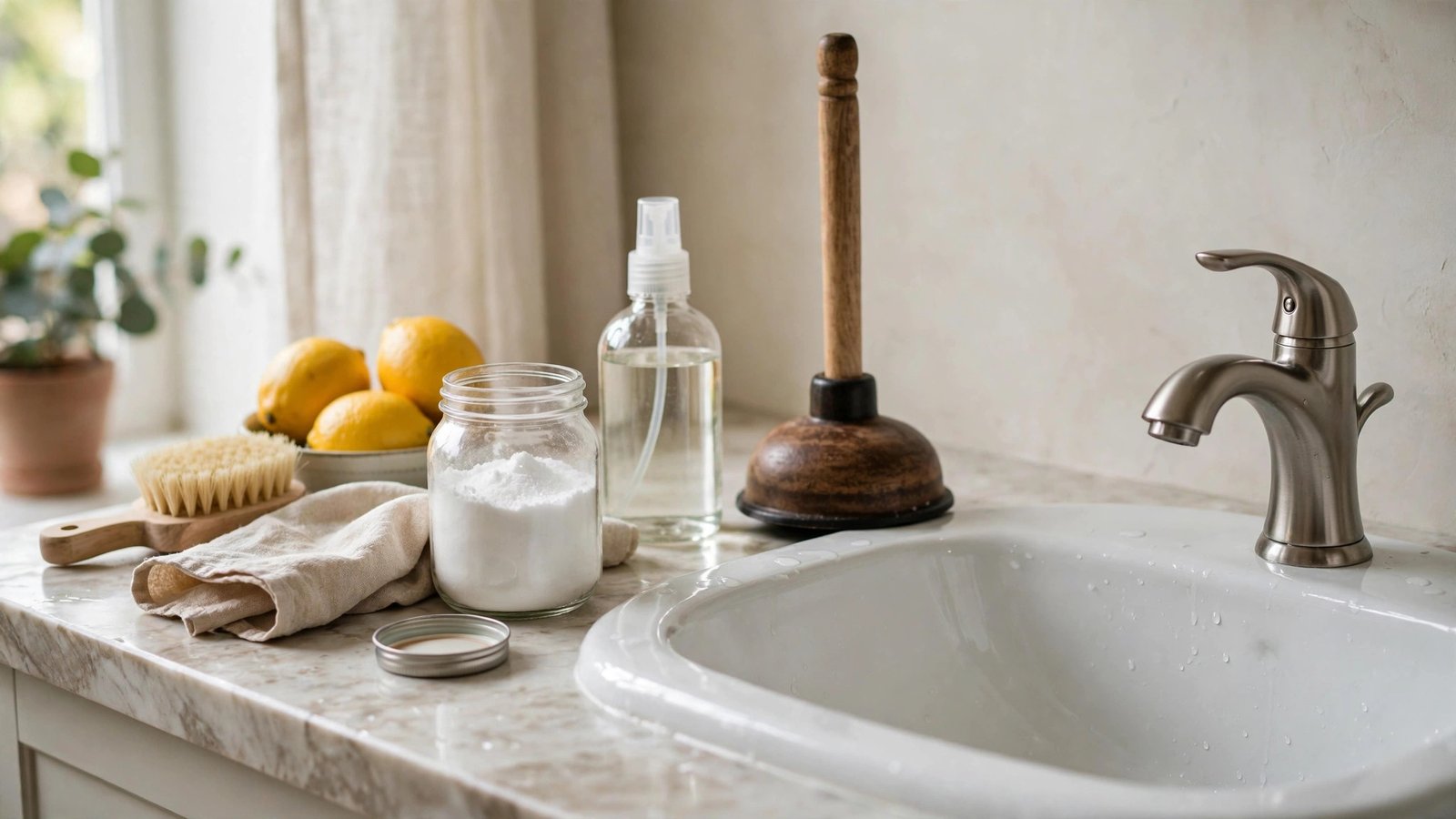
A slow bathroom sink is one of those small annoyances that compounds daily — the basin fills while you brush your teeth, the water glugs down reluctantly, and you start eyeing the bottle of chemical drain cleaner under the sink. Resist that urge. Chemical drain cleaners (sodium hydroxide or sulfuric acid based) can damage pipes, destroy the finish on fixtures, create toxic fumes in a small bathroom, and cause chemical burns — and they often fail on the actual culprit in bathroom sinks, which is almost always a wad of hair and soap scum, not something chemicals dissolve well. The mechanical methods below are cheaper, safer, and dramatically more effective.
Step 1: Clear the Stopper and Visible Gunk (5 Minutes)
Most bathroom sink clogs live within the first few inches — in and around the drain stopper. Pop-up stoppers collect an astonishing mat of hair, soap scum, and toothpaste: lift the stopper out (most pull straight up; some unscrew; pivot-rod types detach by unclipping the rod under the sink) and clean it thoroughly. Then look down the drain with a flashlight — you will often see the clog itself, a dark mass just below the opening. Pull it out with tweezers, needle-nose pliers, or a bent wire hanger. This single step resolves a large percentage of slow bathroom drains, because the clog is usually a hairball wrapped around the stopper mechanism, not deep in the pipes. Clean the stopper assembly, reassemble, and test before doing anything else. The EPA’s Safer Choice guidance recommends mechanical methods over chemical cleaners for exactly this reason — most clogs are physical, not chemical, problems.
Step 2: The Drain Snake / Hair Tool ($5, 10 Minutes)
For clogs just beyond reach, the $5 plastic drain hair-removal tool (sold as Zip-It and similar) is the highest-value plumbing tool ever made: a flexible barbed strip you push down the drain, twist, and pull back up with the clog attached. It is disgusting and magnificent in equal measure. Feed it past the stopper area, work it gently up and down, and pull slowly — the barbs grab hair that no chemical can dissolve. For deeper clogs, a 25-foot hand-crank drum auger ($25 to $35) reaches into the wall pipe; feed it slowly, crank through resistance, and retract carefully. Never force an auger aggressively — you can scratch porcelain or, in old homes, puncture corroded pipes. Run hot water for a minute after clearing to flush loosened debris. Between the stopper cleaning and the hair tool, roughly 90 percent of bathroom sink clogs are resolved without touching a chemical.
Step 3: Baking Soda, Vinegar, and Boiling Water (the Honest Version)
The internet’s favorite volcano — baking soda followed by vinegar — gets oversold as a drain miracle. Here is the honest version: it is a mild cleaning maintenance step, not a clog-buster. The fizzing action can loosen light soap-scum buildup on pipe walls, but it will not dissolve a hair clog. Still, it has a legitimate place in the sequence: after mechanical clearing, pour half a cup of baking soda down the drain, follow with half a cup of white vinegar, cover the drain for 15 minutes, then flush with a kettle of near-boiling water (not a rolling boil on PVC pipes — very hot tap water is safer for plastic). This cleans residual film and deodorizes. Used monthly as maintenance, it genuinely slows the re-accumulation of soap scum. Just do not expect it to power through a real blockage — that is what the $5 hair tool is for. The Family Handyman’s drain-cleaning guides rank mechanical methods above home-chemistry for the same reason.
Step 4: Plunging a Sink (Technique Matters)
A plunger works on sinks, but bathroom sinks need specific technique. Use a cup plunger (the simple dome kind, not the flange toilet kind). Seal the overflow hole — the small opening near the top of the basin — with a wet rag; without this seal, plunging pressure escapes through the overflow and accomplishes nothing. Fill the basin with 2 to 3 inches of water to cover the plunger cup, seat the plunger firmly over the drain, and plunge vigorously 15 to 20 times. The hydraulic pressure dislodges clogs that tools missed, especially soap-scum blockages deeper in the trap. If the sink has a pop-up stopper, remove it first or hold it open — a closed stopper blocks the pressure wave. Plunging after mechanical clearing (not before) gives the best results, since the tools remove the bulk and the plunger clears the remainder.
When the Clog Is Deeper (P-Trap and Beyond)
If everything above fails, the clog is in the P-trap (the U-shaped pipe under the sink) or the wall pipe — and the P-trap is designed to be removed by hand. Place a bucket underneath, unscrew the two slip nuts (channel-lock pliers if they are tight — turn counterclockwise), and pull the trap down. Clean it out (the clog is often sitting right there), check the trap for corrosion while it is off, and reassemble — hand-tighten the nuts, then a quarter-turn with pliers; overtightening cracks plastic traps. If the wall pipe beyond the trap is clogged, feed your drum auger into it. Call a plumber if: multiple fixtures are backing up simultaneously (main-line issue), you smell sewage (vent or sewer problem), or the pipes are corroded galvanized steel that crumbles when touched. But a single slow bathroom sink? That is a hairball, and it is yours to defeat.
Unclog a bathroom sink without chemicals by cleaning the stopper assembly first, pulling the clog with a $5 plastic hair-removal tool, plunging with the overflow sealed, and removing the P-trap if needed. Bathroom sink clogs are almost always hair and soap scum — physical blockages that mechanical tools remove and chemicals usually cannot.
Conclusion
Chemical drain cleaners are the wrong tool for bathroom sinks: the clog is hair and soap scum, and mechanical removal beats chemistry every time. Clean the stopper, snake the drain with a barbed hair tool, plunge with proper technique, and clean the P-trap if necessary — total cost under $10, total time under 30 minutes, zero toxic fumes. Save this sequence; bathroom sinks clog again, and now you will never need the chemical bottle. For more DIY plumbing guides, browse our home improvement section, meet the team, or send us your questions.
Frequently Asked Questions
Why should I avoid chemical drain cleaners?
They can damage pipes (especially older metal and PVC), ruin fixture finishes, produce toxic fumes in small bathrooms, and cause severe chemical burns. Worse, they are ineffective against hair clogs — the most common bathroom sink blockage — since they cannot dissolve hair efficiently.
What is the black gunk in my bathroom sink drain?
A mat of hair, soap scum, toothpaste, and biofilm (bacteria) that accumulates around the stopper mechanism. It is harmless but flow-blocking, and it pulls out in one satisfying mass with a hair-removal tool. Regular stopper cleaning prevents it from building up.
Does baking soda and vinegar really unclog drains?
Not really — it is a mild maintenance cleaner, not a clog-buster. The fizzing loosens light soap film on pipe walls but cannot dissolve hair clogs. Use it after mechanical clearing for cleaning and deodorizing, or monthly for prevention.
How do I remove a bathroom sink stopper to clean it?
Most lift-and-turn or push-pop stoppers pull straight up or unscrew counterclockwise. Pivot-rod stoppers (with a rod under the sink) require unclipping the rod from the drain tailpiece first. Take a photo before disassembly for easy reassembly.
When should I call a plumber for a slow drain?
When multiple fixtures back up at once (suggesting a main-line blockage), when you smell sewage, when the P-trap or pipes are corroded and crumbling, or when mechanical methods and trap cleaning have all failed. A single slow bathroom sink is almost always DIY-fixable.
Leave a Reply