
A website can look polished, publish regularly and still be part of a link farm. These networks exist mainly to create or sell backlinks that influence search rankings, rather than to serve readers. For businesses, publishers and app owners, the challenge in 2026 is separating those schemes from ordinary sites that happen to link to one another. A careful review of a site’s content, links and publishing patterns can help you avoid risky placements and protect the credibility of your own website.
What a Link Farm Is—and What It Is Not
Link farms are groups of websites that exchange, sell or place links primarily to manipulate search rankings. Some are obvious networks with thin pages and repeated links between the same domains. Others try to look like ordinary blogs, directories or news sites, and may approach businesses with offers of guest articles or “guaranteed” backlinks.
Not every site with many outgoing links is a link farm. A resource page, professional directory or publication may link to many useful sources for legitimate reasons. The key question is whether the links make sense for readers and whether the site has a real purpose beyond passing ranking signals. Search engines can treat manipulative link patterns as spam, and a link that initially seems like a shortcut may create cleanup work or weaken trust in a site.
Warning Signs to Check Before Accepting a Link
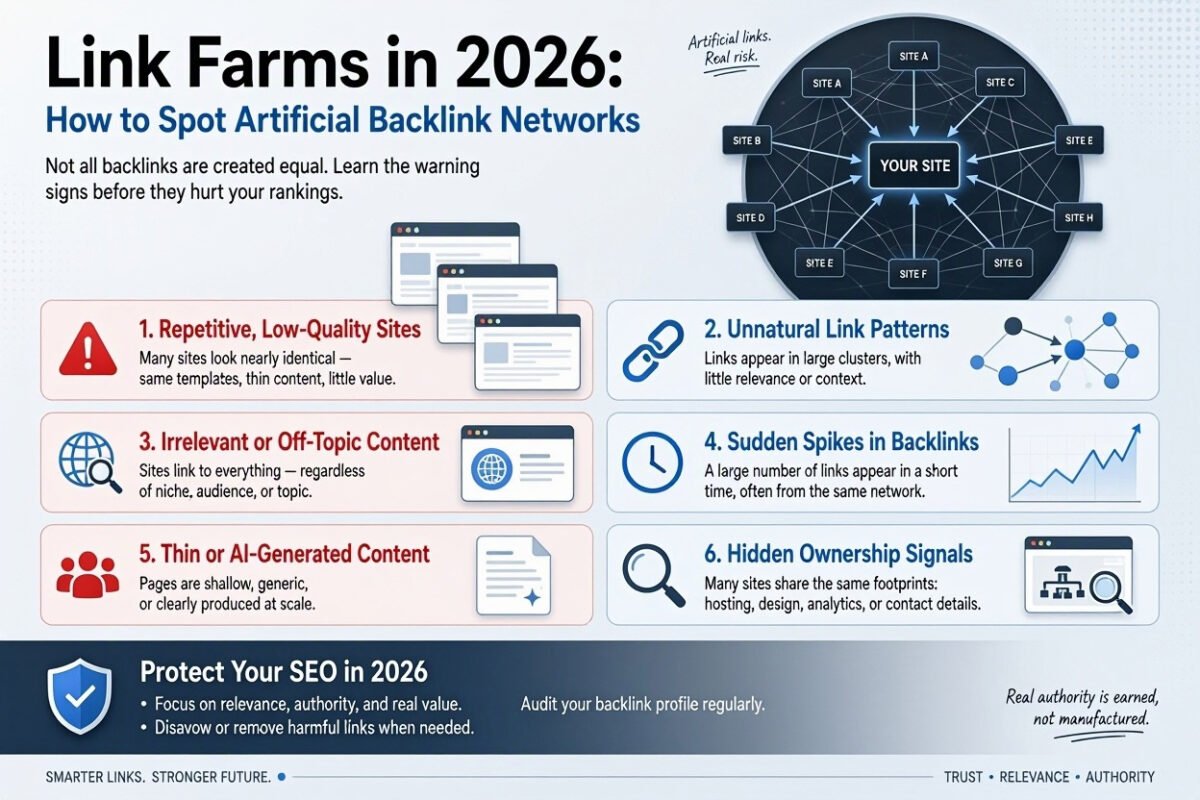
One clue rarely proves anything on its own. Look for several signs together, and assess the site in context rather than judging it by a single metric.
- Unrelated subjects: A site publishes about cryptocurrency, home repair, skin care and app development with no clear editorial focus. Broad coverage can be legitimate, but an abrupt mix of unrelated topics may signal that content is being produced to host paid links.
- Thin or repetitive articles: Posts may be short, generic and built around keywords, with little reporting, experience or practical detail. Repeated introductions and near-identical page structures are worth investigating.
- Links that do not fit: A sentence about a recipe suddenly points to a software company, or several commercial links appear in a paragraph that offers no useful context. Natural links help readers understand or verify a point.
- Unusual publishing patterns: A large burst of posts, many author names with no history, or articles published at a pace that seems disconnected from the site’s audience can indicate that the pages exist mainly to sell placements.
- Promises of ranking results: Be cautious of sellers promising a fixed number of powerful backlinks, guaranteed search positions or links from a “private network.” No outside provider can guarantee how a search engine will rank a page.
A Practical Review Before You Say Yes
Start by reading several recent articles, not just the page offered for your link. Would a real reader have a reason to visit again? Do the articles show consistent editing and subject knowledge? Check whether the site has a clear identity, an identifiable audience and a reasonable connection between its content and your business.
Then inspect the proposed link itself. Ask where it will appear, what surrounding text will say and whether the destination genuinely supports the article. A link to a relevant explanation or tool can be useful; a keyword-heavy anchor inserted into an unrelated paragraph is harder to justify. Review the site’s other outbound links as well. If every article appears to promote a different business, the site may be selling placements without meaningful editorial standards.
For a closer look at common network tactics and current examples, read this guide to spotting link farms. Use it as a checklist, not as a substitute for your own review: sites change, and a sensible decision depends on the specific page, link and audience.
Guest Posts and Backlinks Without the Shortcut
Guest posting is not automatically manipulative. A useful article written for a relevant publication can introduce a business to readers who would value its expertise. The problem is treating the article as a container for a paid, keyword-rich link while offering little to the publication’s audience. If you are considering guest-post opportunities, judge each publication by its readers and editorial fit, not by a promise that a backlink will deliver a particular ranking.
Keep records of placements, payment terms and the page where each link appears. If a vendor will not identify the publisher in advance, explain its editorial process or clarify whether links are sponsored, pause before committing. Paid placements should be handled transparently and according to applicable search-engine guidance; disguising an advertisement as an independent recommendation is a poor long-term strategy.
Why This Matters to App Businesses, Too
Search visibility is only one part of launching a digital product. An app business also needs a workable development budget, a useful product and a plan for reaching customers. Founders comparing build costs can consult Osdire’s mobile app pricing breakdown while weighing development against marketing expenses. The broader point is to spend on work that creates durable value, rather than assuming a pile of questionable links will compensate for weak content or an unclear product.
What to Do If You Find Suspicious Links
If you discover questionable links pointing to your own site, first determine whether they are actually affecting your pages and whether you or an agency arranged them. Save records of the domains and any outreach, then contact the provider if the links came from a campaign you commissioned. Avoid reacting to every unfamiliar link: the web naturally accumulates spam, and indiscriminate removal efforts can waste time. If you have clear evidence of a manipulative campaign or a manual action, follow current search-console guidance or seek advice from a qualified SEO professional.
The safest approach is straightforward: earn links by publishing something worth citing, contributing useful expertise and building relationships with relevant publications. A link farm may offer speed, but its sites often lack the audience and editorial trust that make a backlink valuable in the first place. Inspect the publication, question guaranteed outcomes and choose links that make sense to the person reading the page.
Filed under: Business