
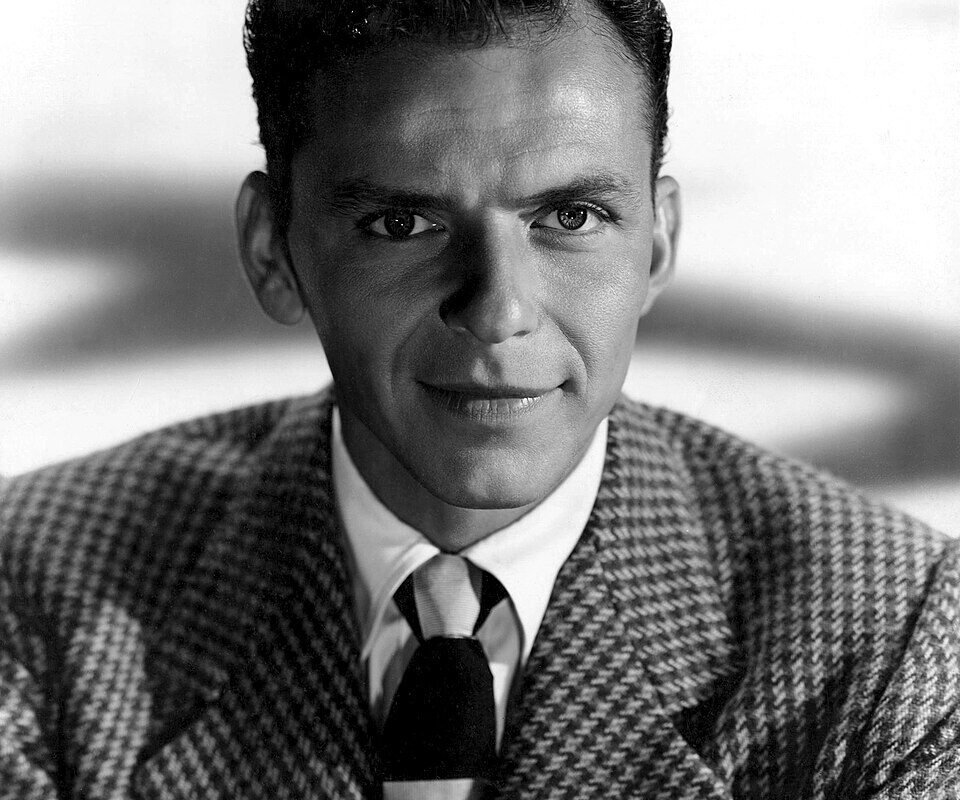
Frank Sinatra’s Fortune at Death: What the Record Actually Shows
Hoboken Born, a Fire-Captain Father and a Midwife Mother
Anthony Martin Sinatra and his wife Natalina welcomed their only child, Francis Albert Sinatra, on 12 December 1915 in Hoboken, New Jersey. The father captained a Hoboken fire company engine and boxed professionally in his youth, and the mother, known to everyone as Dolly, worked as a midwife and wielded real influence in local politics. The household spoke with the confidence of people who held standing in their neighborhood, and the son absorbed the confidence whole.
Sinatra attended high school in Hoboken and left without graduating, and he worked a string of jobs, including a newspaper copy boy stint and shipyard work, while he chased singing work. A radio contest win with the Hoboken Four in 1935 gave him his first tour, and local bandleader Harry James hired him in 1939 after hearing him on a late-night radio broadcast. The apprenticeship had begun, and the boy from Hoboken never held an ordinary job again.
Big Bands to Reprise: Six Decades, and Ownership Along the Way
1939 — The Big-Band Apprenticeship
Sinatra sang with Harry James’s orchestra in 1939 and cut his first commercial records, then jumped to Tommy Dorsey’s band in 1940 and found the vast audience radio could give a singer. Dorsey’s trombone phrasing taught him breath control, and Sinatra later credited those two years for his entire technique. He left Dorsey in 1942 as the most talked-about young vocalist anywhere.
1943 — The Solo Breakthrough
His solo engagement at New York’s Paramount Theatre in late 1942 triggered scenes that newspapers struggled to describe: thousands of young fans, the bobby-soxers, screamed through every show. Sinatra signed with Columbia Records in 1943, and his early Columbia singles, including “All or Nothing at All”, sold in the millions. A singer now stood as a solo attraction on a scale popular music had never produced.
1946 — The Voice
Columbia released The Voice of Frank Sinatra in 1946, and the collection topped the album chart and showed the industry that a singer could sell a mood across a full long-playing set. Sinatra’s popularity peaked that year: fan clubs counted members in the thousands, his radio programs drew enormous audiences, and his singles crowded the charts in bunches. The decade also brought strain, vocal trouble and changing tastes, and the peak made the collapse that followed look total. The recordings from the Columbia years nonetheless kept selling through every later era.
1953 — The Capitol Reinvention
The early 1950s nearly ended him: his voice faltered, Columbia dropped him, and the teen audience moved on. Sinatra answered with the great comeback of popular music. He signed with Capitol Records in 1953, won an Academy Award for his dramatic acting that same season, and began the album partnership with arranger Nelson Riddle that redefined the long-playing record. His Rat Pack partner Dean Martin traveled the same road from singer to all-round entertainer, and readers can open Dean Martin’s net worth profile for that parallel record.
1955 — In the Wee Small Hours
Capitol released In the Wee Small Hours in 1955, and critics then and since treat the album as a landmark: sixteen songs of loss and late-night reflection, sequenced as one sustained mood. Songs for Swingin’ Lovers! followed in 1956 with “I’ve Got You Under My Skin”, and Come Fly with Me topped the album chart in 1958. Sinatra had turned the album itself into an art form, and the catalog from these years still anchors his estate’s recording income.
1960 — Reprise and Ownership
Sinatra founded his own label, Reprise Records, in 1960, and the move changed his financial life as much as his artistic one. He now owned a share of the machine that sold his records. “Strangers in the Night” gave Reprise a number one single and a Grammy in 1966, September of My Years won the Grammy for Album of the Year, and he sold Reprise to Warner Bros. in 1963 while keeping his own recording arrangement inside the deal.
1969 — My Way
Paul Anka adapted a French melody and wrote English words for his friend, and “My Way” became Sinatra’s signature recording in 1969. The song’s chart life in Britain stretched across years, and its lyric hardened into the public summary of his career. Sinatra himself grew weary of the song, yet audiences demanded it at every concert until the end, and its publishing income still flows to the estate.
1980 — New York, New York and the Final Decades
“Theme from New York, New York” arrived in 1980 and gave a 64-year-old singer one last anthem. Sinatra announced a retirement in 1971 and reversed it within two years, and he toured the world through the 1980s and into the 1990s at fees few performers of any age commanded. His Duets album of 1993 sold in the millions by pairing his voice with younger stars, and he gave his final concert performances in 1995, months before his eightieth birthday.
1993 — Duets
Capitol paired the 77-year-old singer with a roster of younger stars for Duets in 1993, and modern studio technology let the guests record their parts in separate cities while Sinatra cut his vocals his own way, in full takes, in the room. The album reached number two on the chart and sold in the millions, and a sequel followed within a year. The project introduced his voice to a new generation of buyers and added a final commercial peak to a recording career that had begun before most of his duet partners’ parents had met.
$200 Million at Death, with Estate Estimates Running to $600 Million
Celebrity Net Worth puts Frank Sinatra’s net worth at $200 million at the time of his death, and that figure leads this report. Sinatra died on 14 May 1998, and any number attached to his name describes a fortune frozen at that date. The $200 million rests on six decades of record sales, concert fees, radio and stage earnings, a record label he founded, and property he accumulated across California and the desert.
The disagreement around the total deserves print, because Celebrity Net Worth itself prints it. Contemporary estate estimates ran from $200 million to $600 million, and nobody ever established the exact amount publicly, because Sinatra held much of his wealth inside a living trust that sat outside probate. This report therefore carries the range alongside the headline: $200 million on Celebrity Net Worth, up to $600 million in contemporary estate reporting, exact total never publicly established.
Two other numbers belong in the record with firm labels. A 1981 Nevada gaming-license statement recorded his declared position at just over $14 million, and that document captures one moment in 1981, nothing more. In 2007 Warner Music Group paid $50 million for a 50 percent stake in Frank Sinatra Enterprises, and that payment counts as a posthumous estate transaction. It swelled the estate’s later earnings, and it forms no part of the at-death figure above. Estate earnings after 1998 and net worth at death stay strictly separate throughout this report.
Twin Palms in 1947, Rancho Mirage Later, and Homes Across California
Property formed a visible slice of the fortune. Sinatra commissioned Twin Palms in Palm Springs in 1947 at a reported cost of $150,000, and the modernist house became his desert base for decades. He later built a compound at Rancho Mirage, and he held homes in Beverly Hills and Malibu as well. His will directed property provisions for his wife Barbara, and the desert compound remained a family asset long after his death. Each price in this paragraph records a purchase or a provision, never a valuation of the whole estate.
Four Marriages, Barbara Marx His Wife Until His Death
Sinatra married four times, and the record states each marriage plainly. He married Nancy Barbato on 4 February 1939, and that marriage ended in 1951. He married Ava Gardner in November 1951, and that marriage ended in 1957. He married Mia Farrow in July 1966, and that marriage ended in 1968. He married Barbara Marx in July 1976, and Barbara remained his wife until his death in 1998; she died in 2017.
All three of his children came from the first marriage. Nancy arrived in 1940 and built her own recording career. Frank Jr. arrived in 1944, worked as a singer and conductor, and died in 2016; kidnappers seized him in December 1963, and his father paid a $240,000 ransom that secured his release unharmed within days. Tina arrived in 1948 and later managed much of the family’s business and legacy work.
His parents shaped the temperament that colleagues described for sixty years. Anthony Martin Sinatra, the fire captain, died in 1969. Dolly Sinatra, the midwife and political operator who had pushed her son’s earliest ambitions, died in January 1977 in a light aircraft accident in California. Sinatra grew up an only child, and biographers return to that fact when they explain both his loyalty to old friends and his demand for loyalty in return.
Sinatra in One Short Record: $200 Million, Six Decades, Four Marriages
| Sinatra in One Short Record: $200 Million, Six Decades, Four Marriages | Details |
|---|---|
| Born | 12 December 1915, Hoboken, New Jersey; died 14 May 1998, aged 82 |
| Age | 82 at death (died 14 May 1998) |
| Height | 5 ft 8 in (1.73 m) |
| Weight | No reliable published figure exists |
| Net Worth | $200 million at the time of his death (Celebrity Net Worth); contemporary estate estimates ran to $600 million |
| Wife | Barbara Marx (m. July 1976 until his death in 1998); previously Nancy Barbato, Ava Gardner and Mia Farrow |
| Children | Nancy (b. 1940), Frank Jr. (b. 1944, d. 2016) and Tina (b. 1948) |
| Parents | Anthony Martin Sinatra (Hoboken fire captain, d. 1969) and Natalina “Dolly” Sinatra (midwife, d. 1977) |
| Songs | All or Nothing at All, I’ve Got You Under My Skin, Strangers in the Night, My Way, That’s Life, Theme from New York, New York |
| Albums | In the Wee Small Hours, Songs for Swingin’ Lovers!, Come Fly with Me, Only the Lonely, September of My Years, Duets |
| House | Twin Palms, Palm Springs (commissioned 1947, reported $150,000); Rancho Mirage compound; Beverly Hills and Malibu homes |
Ownership Instincts Kept the True Total Beyond Proof
Sinatra’s legacy rests on a body of recordings that critics rank at the summit of popular singing, and his estate position rests on the ownership instincts he showed at Reprise and in his publishing arrangements. Celebrity Net Worth counts $200 million at his death, contemporary estimates ran as high as $600 million, and the living trust structure he chose keeps the true total permanently beyond public reach. The range, honestly printed, tells the story better than any single number could.
The estate kept earning after 1998 through catalog sales, licensing and transactions such as the 2007 Warner Music Group payment of $50 million for half of Frank Sinatra Enterprises, and those earnings belong to the estate’s later history rather than to the fortune he held on the day he died. He died on 14 May 1998 at Cedars-Sinai Medical Center in Los Angeles after a heart attack, his wife Barbara at his side, and he left behind a catalog that still defines its genre. The record closes there: a singer from Hoboken who owned his work, and whose work outearns most living performers a generation after his death.
Filed under: Net Worth