
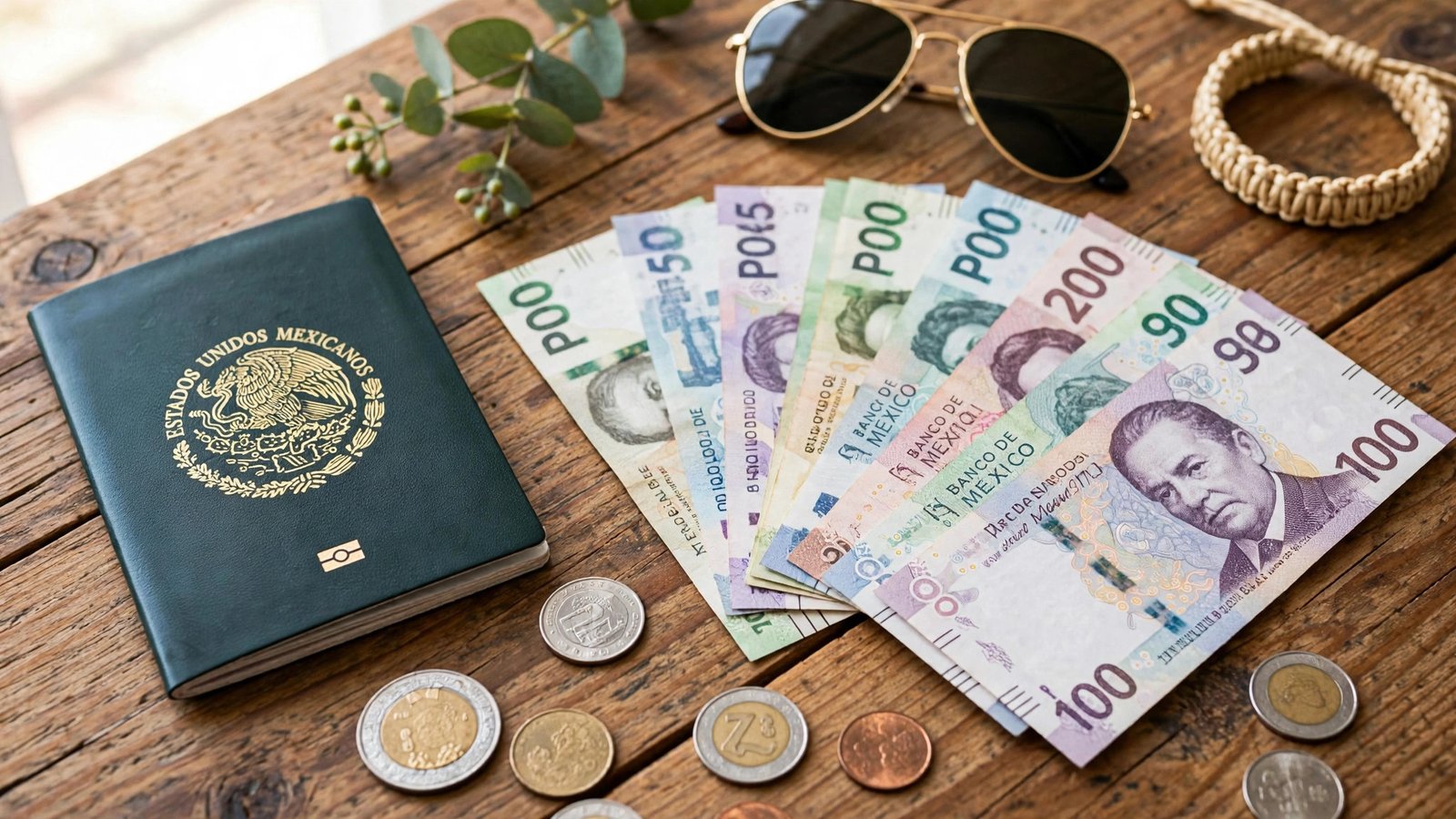
You are heading to Mexico and wondering where to get pesos — the airport kiosk with its terrible rates, your bank, or just wing it with dollars? The answer matters more than most travelers realize: the spread between the best and worst exchange methods can cost 10-15% of your spending money, which on a $1,500 trip budget is $150-$225 vanishing into fees and bad rates. The good news is that the best method is also the simplest, and it does not involve standing in line at a currency counter. Here is the ranked guide to getting pesos the smart way.
The Best Method: ATM Withdrawals in Mexico
For most travelers, the winner is withdrawing pesos from ATMs in Mexico using a debit card with no foreign transaction fees. Mexican bank ATMs (Banorte, Santander, HSBC Mexico, Citibanamex) offer exchange rates very close to the interbank rate — far better than any U.S.-side exchange counter — and the flat ATM fee (typically 30-60 pesos, or $1.50-$3) is trivial on reasonable withdrawals. The strategy: withdraw larger amounts less frequently to minimize the flat fee’s impact, use ATMs inside banks or malls (safer and less prone to skimming than standalone street ATMs), always decline the ATM’s “conversion” offer (choose to be charged in pesos, not dollars — the ATM’s conversion rate is a markup in disguise), and notify your bank of travel dates beforehand. Charles Schwab and similar no-fee checking accounts reimburse all ATM fees worldwide, making this method essentially free. The State Department’s Mexico travel guidance recommends using bank-affiliated ATMs during daylight hours as both the economical and the safe choice.
The Runner-Up: Your Bank Before You Leave
Ordering pesos from your U.S. bank before departure is the best option if you want cash in hand on arrival. Most major banks (Chase, Bank of America, Wells Fargo) sell foreign currency with 1-3 business days’ notice — the exchange rate includes a modest markup (typically 3-5% over interbank), which is worse than Mexican ATMs but far better than airport kiosks. Order only what you need for the first day or two (arrival taxi, tips, first meals) — $100-$200 worth — and get the rest from ATMs in Mexico. Request small denominations: Mexican vendors, taxis, and beach sellers often cannot break large bills, and 500-peso notes can be genuinely hard to spend outside major establishments. Some banks waive the delivery fee for account holders or allow branch pickup. This method’s real value is psychological: landing with pesos eliminates the arrival scramble and the temptation of the airport exchange counter, which is where the worst rates in the entire trip live.
What to Avoid: Airport Kiosks and Hotel Exchanges
The currency exchange counters at U.S. airports routinely offer rates 8-15% worse than the interbank rate, plus service fees — they are the single most expensive way to get pesos, trading entirely on traveler anxiety and convenience. Mexican airport kiosks are somewhat better but still poor. Hotel front desks exchange at bad rates as a convenience service, not a competitive one. U.S.-based “currency exchange” storefronts vary but rarely beat banks. And never exchange with street money-changers, regardless of the quoted rate — counterfeit risk and outright scams are real. The pattern is consistent: anywhere that profits from your urgency or ignorance charges for it. If you must exchange at an airport (missed planning, emergency), exchange the minimum viable amount and use ATMs for the rest. One more trap: paying in U.S. dollars at Mexican businesses — vendors who accept dollars set their own exchange rate, invariably a bad one. Always pay in pesos when given the choice.
Credit Cards: The Unsung Hero
For most purchases in Mexico, the best exchange rate of all comes from simply paying with a no-foreign-transaction-fee credit card. Visa and Mastercard convert at near-interbank rates with zero markup when your card charges no foreign transaction fee — better than cash exchange in almost every scenario. Use cards for hotels, restaurants, tours, and larger purchases; save cash for taxis, markets, beach vendors, tips, and small towns where cards are not accepted. The caveats: always choose to be charged in pesos (not dollars) when the terminal offers — “dynamic currency conversion” is a markup dressed as convenience. Carry a backup card from a different network. And understand the fraud-protection advantage: credit cards offer far stronger dispute rights than debit if something goes wrong. The Consumer Financial Protection Bureau’s travel guidance recommends no-foreign-fee credit cards as the primary spending tool abroad, with ATM cash as the complement — a combination that minimizes both fees and risk.
The Practical Cash Plan
Put it together: before departure, order $100-$200 in small-denomination pesos from your bank. Bring two debit cards (primary plus backup) from accounts with no foreign transaction fees, and two credit cards with no foreign fees. In Mexico, withdraw 5,000-8,000 pesos at a time from bank ATMs, declining conversion offers. Pay by card wherever accepted (in pesos), cash where not. Keep daily cash in a front pocket or money belt and the bulk secured at the hotel. Tip in pesos — service workers prefer it and you avoid the mental math of dollar tipping. At trip’s end, spend down remaining pesos (airport shops, final taxi) rather than exchanging back — reconversion rates punish you twice. Leftover coins make fine souvenirs. This plan typically costs under 2% in total fees and spreads, versus 10-15% for the kiosk-and-hope approach — on a two-week trip, that is the difference between a nice dinner out and money left on the exchange counter.
The best way to get pesos is Mexican bank ATMs with a no-fee debit card (decline the conversion offer), supplemented by a small amount ordered from your U.S. bank before departure and a no-foreign-fee credit card for purchases. Avoid airport kiosks, hotel desks, and paying in dollars — the convenience markup is brutal.
Conclusion
Exchanging dollars for pesos before a Mexico trip is best done in layers: a small amount from your bank for arrival, ATM withdrawals in Mexico for the bulk (no-fee card, decline conversion), and a no-foreign-transaction-fee credit card for purchases. Skip the airport kiosks, hotel desks, and dollar payments entirely. The right method costs under 2%; the wrong one costs 15%. For more travel money guides, browse our travel section, learn about our team, or share your currency tips.
Frequently Asked Questions
Should I exchange dollars for pesos before leaving the US?
Get a small amount ($100-$200) from your bank for arrival day, but get the bulk from ATMs in Mexico — the rates are significantly better. Avoid airport exchange kiosks entirely; they charge 8-15% over fair rates.
Is it better to use ATMs or exchange cash in Mexico?
ATMs at Mexican banks win — near-interbank rates plus a small flat fee ($1.50-$3). Always decline the ATM’s currency conversion offer and choose to be charged in pesos. Use bank-affiliated ATMs in daylight for safety.
Can I just use US dollars in Mexico?
You can in tourist areas, but you will overpay — vendors set their own dollar exchange rates, always in their favor. Pay in pesos whenever given the choice, by cash or by card.
Do I need a special bank account for fee-free ATM use abroad?
It helps enormously. Accounts like Charles Schwab’s reimburse all ATM fees worldwide and charge no foreign transaction fees. At minimum, use a debit card with no foreign transaction fee to avoid the typical 3% surcharge.
Should I pay in pesos or dollars on my credit card in Mexico?
Always pesos. The “pay in dollars” option (dynamic currency conversion) applies the merchant’s markup instead of your card network’s near-interbank rate. With a no-foreign-fee card, pesos is always the better choice.
Leave a Reply