
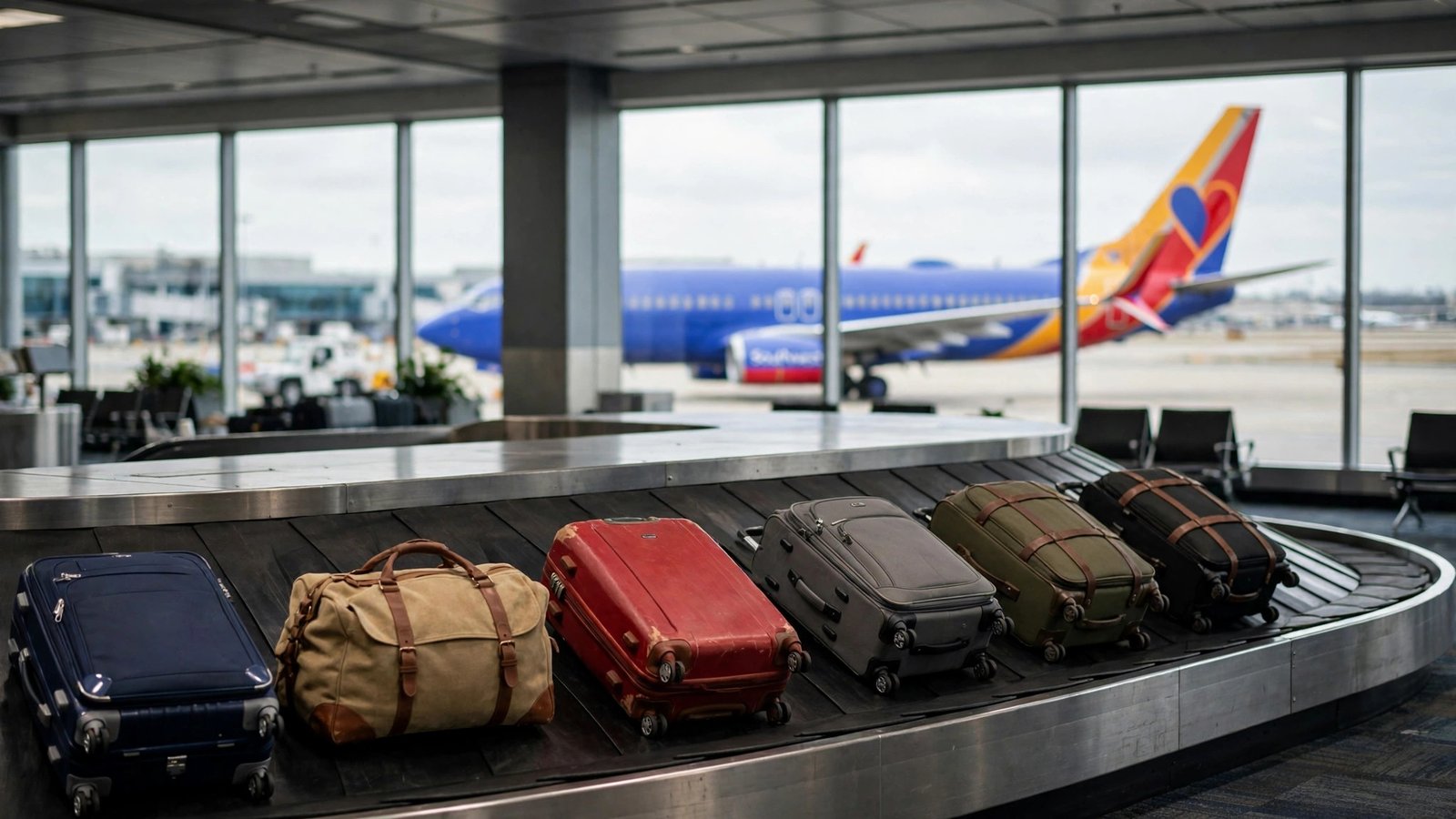
Here is the delightful secret of Southwest Airlines baggage policy: for most travelers, there are no baggage fees to avoid — Southwest famously includes two free checked bags per passenger, a policy that has survived decades while every other major U.S. airline charges $35-$40 for the first bag. But “two free bags” comes with fine print, edge cases, and situations where fees do appear — overweight bags, oversized bags, third bags, sports equipment, and pets. And if you are comparing Southwest against ultra-low-cost carriers or trying to travel truly light, there are strategies that go beyond the free allowance. Here is the complete guide to paying nothing (or as little as possible) for your bags on Southwest.
Know the Free Allowance Cold
Southwest’s standard policy: two checked bags fly free per ticketed passenger, each up to 50 pounds and 62 linear inches (length + width + height). That is extraordinarily generous — a family of four checks eight bags free, a value of roughly $560 compared to legacy carriers’ roundtrip bag fees. The bags must be checked at the ticket counter or kiosk; curbside check-in expects a tip but charges no fee. Your personal item and carry-on are also free, with standard size limits. The key details that trip people up: the 50-pound limit is strict — 51 pounds triggers the overweight fee, so weigh bags at home with a $12 luggage scale. The 62-inch size limit excludes most standard suitcases but catches oversized gear. And the policy applies per passenger, not per reservation — lap infants do not get their own allowance. Internal Southwest data has long shown bags-fly-free as a top reason travelers choose the airline; the official Southwest baggage policy page is the authoritative source, and it is worth a re-read before every trip since policies evolve.
When Fees Do Appear (and How to Dodge Them)
Free has boundaries. Third and additional checked bags cost $150 each one-way (up from the old $75) — steep by design. Overweight bags (51-100 lbs) cost $150 per bag one-way; over 100 lbs and Southwest will not accept the bag at all. Oversized bags (63-80 linear inches) also run $150. The dodges: redistribute weight between your two free bags before leaving home — two 48-pound bags are free, one 55-pound bag costs $150. For a third bag’s worth of stuff, ship it: UPS/FedEx ground for a 30-pound box often costs $25-$40, far less than $150, and it arrives without the airport hassle. Sports equipment follows special rules: golf clubs, skis, and surfboards in proper cases often count as one of your two free bags if within size/weight limits — check the sports equipment policy for your specific gear, because surfboards and bikes have quirks. Pets in cabin cost $125 each way and do not count as baggage — that fee is unavoidable, so factor it into the trip math honestly.
Travel Light Anyway: The Carry-On Strategy
Even with free checked bags, carry-on-only travel has real advantages: no baggage claim wait, no lost-luggage risk, faster airport exits. Southwest’s carry-on allowance (one carry-on plus one personal item, standard size limits) fits a surprising amount with packing discipline. The method: a carry-on suitcase packed with the 5-4-3-2-1 rule (five tops, four bottoms, three accessories, two pairs of shoes worn/included, one hat) covers a week; wear your bulkiest items on the plane; use packing cubes to compress; do laundry mid-trip for longer stays. Liquids follow the TSA 3-1-1 rule in carry-ons — the one real constraint. Families: kids’ car seats and strollers fly free as checked items on Southwest (in addition to the two-bag allowance), so the carry-on strategy works even with little ones. The TSA’s packing guidance confirms what frequent flyers know: the vast majority of travelers overpack by 30-40%, and the carry-on forces the discipline that checked bags forgive.
Elite Status and Credit Cards: The Multipliers
If you fly Southwest regularly, status and cards compound the baggage advantage. A-List and A-List Preferred members get priority boarding and other perks (the bags were already free). The real baggage-adjacent value is in Southwest’s co-branded credit cards: while they do not add bag allowances (there is nothing to add), they offer priority boarding, anniversary points, and checked-bag-adjacent perks like the Companion Pass — which effectively doubles every benefit including free bags for your companion. For travelers who split time between Southwest and other airlines, a general travel credit card with airline fee credits can cover the bag fees on those other carriers. But the honest math: if baggage fees are your main pain point, simply flying Southwest more often is the answer — two free bags per person per flight is worth hundreds annually for regular travelers, no card required. Run your own numbers: multiply your typical yearly checked bags by $70 roundtrip on legacy carriers, and the Southwest advantage becomes concrete.
Compare Honestly Against Budget Carriers
The baggage-fee conversation often starts with “but Spirit was $89” — so do the full comparison. A Spirit or Frontier fare plus one checked bag ($60-$75 each way when bought in advance, more at the airport), plus a carry-on fee ($50+), plus seat selection, quickly meets or exceeds Southwest’s all-in fare on the same route — with Southwest’s free cancellation and no change fees as a bonus. The comparison method: price the entire trip (fare + all bags + seats) on each airline before deciding, not just the headline fare. Southwest’s transparent pricing usually wins for anyone checking a bag; the ultra-low-cost carriers win mainly for true minimalists traveling with only a personal item. Also factor in the soft costs: Southwest’s customer-friendly change policy means a schedule change costs nothing, while budget carriers charge for everything. For families and anyone with real luggage, the “free bags” policy is not a perk — it is the pricing model, and it is usually the cheapest total.
Southwest’s two-free-checked-bags policy means most travelers never pay baggage fees — the game is staying within 50 pounds and 62 inches per bag. Redistribute weight at home, ship instead of paying $150 for a third bag, and price budget carriers as total trips before assuming they are cheaper.
Conclusion
Avoiding baggage fees on Southwest Airlines mostly means understanding the generous free allowance: two bags per passenger up to 50 pounds and 62 inches, with fees only for third bags, overweight, and oversized items. Weigh bags at home, redistribute weight, ship overflow instead of paying $150, travel carry-on when it suits you, and compare total trip costs honestly against budget carriers. The bags fly free — keep them within the limits and they stay that way. For more travel-smarts guides, browse our travel section, learn about our team, or share your best packing win.
Frequently Asked Questions
Does Southwest really offer two free checked bags?
Yes — two checked bags per ticketed passenger, each up to 50 lbs and 62 linear inches, fly free. It is the most generous standard baggage policy among major U.S. airlines and applies to every fare type.
How much is a third bag on Southwest?
$150 each way — deliberately steep. For a third bag’s worth of items, shipping via UPS or FedEx ground ($25-$40 for a typical box) is almost always cheaper than the airline fee.
What happens if my bag is overweight on Southwest?
Bags 51-100 lbs cost $150 each way; bags over 100 lbs are not accepted. Weigh bags at home with a luggage scale and redistribute weight between your two free bags — two 48-pound bags are free.
Do car seats and strollers count toward the bag limit?
No — children’s car seats and strollers fly free as checked items in addition to the two-bag allowance per passenger. This makes Southwest particularly family-friendly for baggage.
Is Southwest or Spirit cheaper with bags included?
For anyone checking bags, Southwest’s all-in fare usually wins once you add Spirit/Frontier bag fees ($60-$75+ each way per bag), seat fees, and extras. Always price the total trip, not the headline fare.
Leave a Reply