
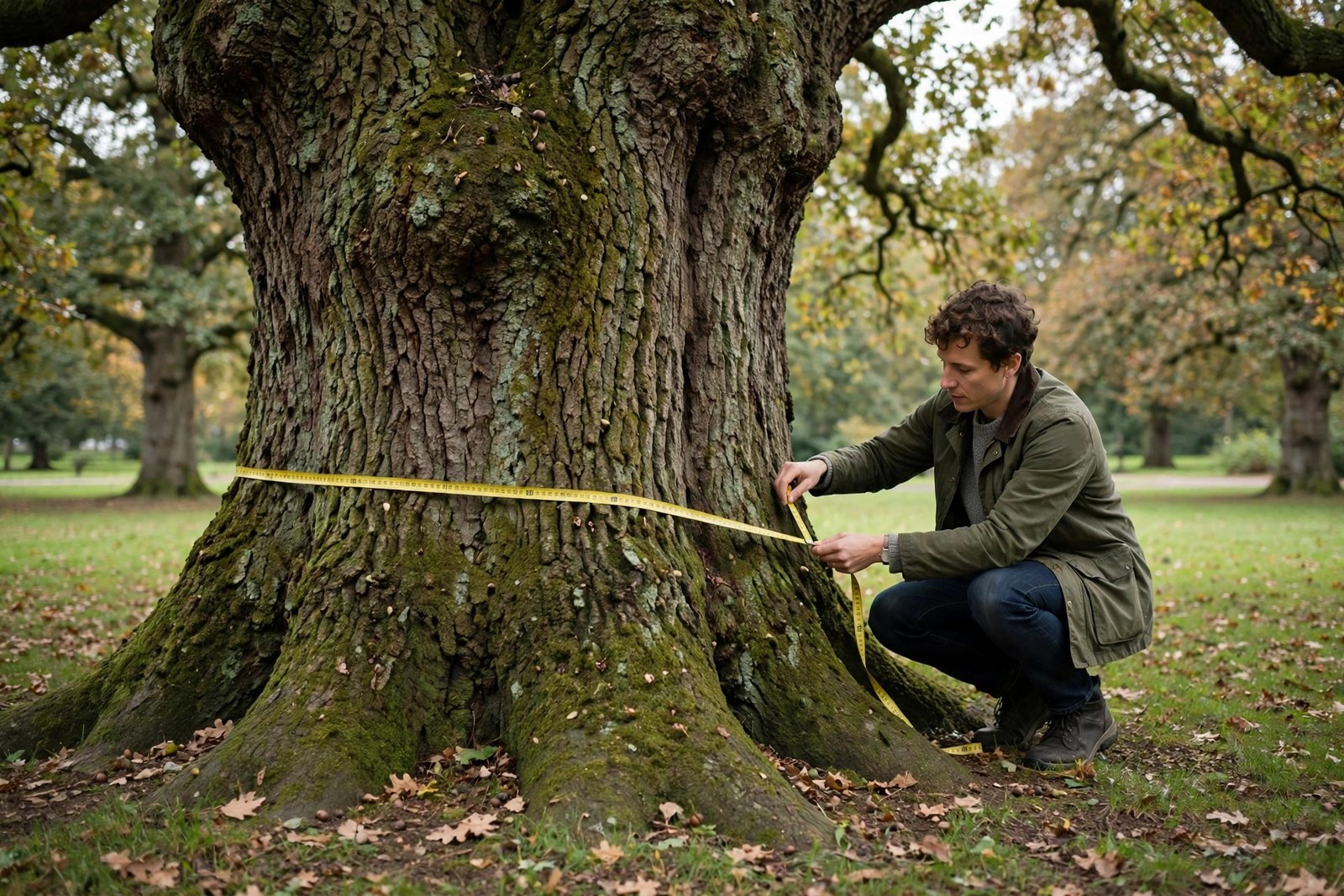
That massive oak in your yard was already old when your grandparents were kids — but how old, exactly? Fifty? A hundred and fifty? The classic method of counting rings requires cutting the tree down, which defeats the purpose rather spectacularly. Fortunately, arborists and foresters have several reliable ways to estimate a tree’s age while it keeps on living. Here is how to tell how old a tree is without cutting it down, from simple girth math you can do this afternoon to the professional tool that reads rings without felling.
Why You Cannot Just Count Rings (Without Cutting)
Trees grow a new ring of wood each year — wide in good years, narrow in droughts — which is why a stump reads like a biography. But accessing those rings on a living tree requires either cutting it (unacceptable) or specialized sampling. The bark hides everything, and outward appearance lies: a fast-growing tree in rich soil can outgrow a slow-growing one three times its age. Two oaks of identical trunk diameter might differ by fifty years depending on sunlight, water, and competition. So every non-invasive method is an estimate, not a count — but good estimates, made carefully, land surprisingly close. The trick is combining methods: girth math plus species knowledge plus historical clues converges on an answer you can trust within a decade or two, which is plenty for satisfying curiosity.
Method 1: Measure the Girth and Do the Math
The easiest method needs only a tape measure. Measure the trunk’s circumference at 4.5 feet above the ground — foresters call this diameter at breast height (DBH), and the standard height keeps measurements comparable. Divide the circumference by pi (3.14) to get the diameter in inches. Then multiply by the species’ growth factor, a number reflecting how fast that species typically grows: white oak is about 5, red oak 4, sugar maple 5, silver maple 3, pine 5, dogwood 7. The formula: diameter × growth factor = approximate age in years. A white oak with a 60-inch circumference has roughly a 19-inch diameter; times the growth factor of 5, that is about 95 years. The Arbor Day Foundation’s tree identification resources include growth factor tables for common species — identify your tree first, then look up its factor. This method works best on open-grown landscape trees; forest trees competing for light grow slower and read younger than they are.
Method 2: Count Branch Whorls on Conifers
Pines, spruces, and firs offer a beautifully simple aging method: they grow one whorl of branches per year. Stand back and count the tiers of branches from the bottom to the top — each whorl represents one year of growth. Add a few years for the seedling stage before the first whorl formed (typically 2–4 years for pines). A pine with 25 whorls is roughly 28 years old. This works best on young to middle-aged conifers; on old trees the lower whorls die and drop off as the canopy shades them, making counts unreliable past a few decades. It also fails on hardwoods like oaks and maples, which do not grow in neat annual whorls. But for the Christmas-tree-sized pine in the yard, whorl counting is fast, free, and remarkably accurate — kids love doing it, and it turns a walk into a math lesson.
Method 3: The Increment Borer (the Professional’s Tool)
When arborists need a real answer, they use an increment borer — a hollow, T-handled drill that extracts a pencil-thin core from bark to center without harming the tree. The core shows every growth ring, readable like a barcode, and the tiny hole compartmentalizes and heals. Borers come in various lengths for different trunk diameters, and using one correctly takes practice: bore at breast height, slightly upward, and extract the core intact. This is the closest thing to counting rings without felling, and it is how researchers date historic trees. The tool costs $100–$200, so it is an investment — but local extension offices, universities, and tree-service companies sometimes lend them or take cores for a small fee. Never bore a tree casually or repeatedly; each hole is a small wound, and the technique exists to serve science and arboriculture, not curiosity alone. Used responsibly, it gives an exact age no estimate can match.
Method 4: Historical Clues and Records
Sometimes the best dating tool is paperwork. Old photographs of your property — county archives, historical societies, even neighbors’ albums — can show whether the tree existed decades ago and how large it was. Property records sometimes note plantings; developers’ landscaping plans occasionally survive in municipal files. Ask long-time neighbors: “Do you remember when that oak was planted?” often yields surprisingly precise answers. Aerial photographs, available through county GIS systems and historical imagery archives, let you watch the canopy grow across decades. For street trees, city forestry departments keep planting records. And local history helps: a tree shading a 1920s farmhouse was likely planted with it, while one in a 1980s subdivision dates to development. Combine a historical anchor (“it was already large in the 1975 photo”) with girth math and your estimate tightens dramatically. The U.S. Forest Service’s tree aging guidance describes how professionals combine these clues for heritage tree assessments.
Why Estimates Vary (and How to Get Closer)
Every method has error bars, and understanding them makes you a better estimator. Open-grown trees with full sun and no competition grow fast and look older than their years; forest trees in crowded stands grow slowly and look younger. Drought years, disease, and root damage all slow growth, while irrigation and fertilizer accelerate it. Growth factors are regional averages — a white oak in Georgia grows faster than one in Minnesota. The practical approach: use two or three methods and look for agreement. If girth math says 90, whorl history suggests 85, and the 1975 photo shows a substantial tree, you can confidently say “about a century.” Precision beyond that requires the borer. And remember the delightful truth underlying all of this: the tree does not care about its exact age. It has been quietly counting its own years in wood, and your estimate is just a way of paying attention.
Age a living tree three ways: measure trunk circumference at 4.5 feet, convert to diameter, and multiply by the species’ growth factor; count annual branch whorls on conifers; or check historical photos and planting records. For an exact answer, an arborist’s increment borer reads the rings from a pencil-thin core without harming the tree.
Conclusion
How can you tell how old a tree is without cutting it down? Start with the tape measure and the growth-factor formula — it takes ten minutes and gets you close. Count whorls on pines, dig into historical photos and neighbor memories, and call in an increment borer when you need certainty. Combine methods, accept the estimate’s honest uncertainty, and enjoy knowing your oak better. For more tree science and nature guides, visit our science section, meet our team, or tell us about the oldest tree you know.
Frequently Asked Questions
How accurate is the growth factor method for aging trees?
Within a couple of decades for open-grown landscape trees — good enough for curiosity, not for science. Accuracy drops for forest trees, stressed trees, or regions far from where the growth factor was calibrated. Combine it with historical clues or whorl counts for a tighter estimate.
Does drilling a tree with an increment borer hurt it?
Minimally, when done correctly. The borer extracts a pencil-thin core, and healthy trees compartmentalize the small wound and continue growing normally. It is the standard research method worldwide. That said, it should be done sparingly and properly — not as a casual experiment on every tree in the yard.
Can you tell a tree’s age from its bark?
Only very roughly. Bark gets rougher and more furrowed with age in many species, but bark appearance varies more with species and growing conditions than with years. It is a supporting clue at best — use girth measurement or whorl counting for actual estimates.
What is the oldest tree I might find in my area?
It depends on your region, but oaks, hickories, and bald cypresses in the eastern U.S. can exceed 300 years, while bristlecone pines in the West live thousands. Your state forestry agency or local historical society often maintains champion-tree registries with verified ages of notable specimens nearby.
Do all trees grow one ring per year?
In temperate climates with distinct seasons, yes — one ring per growing season. Tropical trees without strong seasonal cycles may grow continuously or irregularly, making ring counting unreliable. Stress events can occasionally produce false or missing rings, which is why professionals cross-date multiple cores.
Leave a Reply