
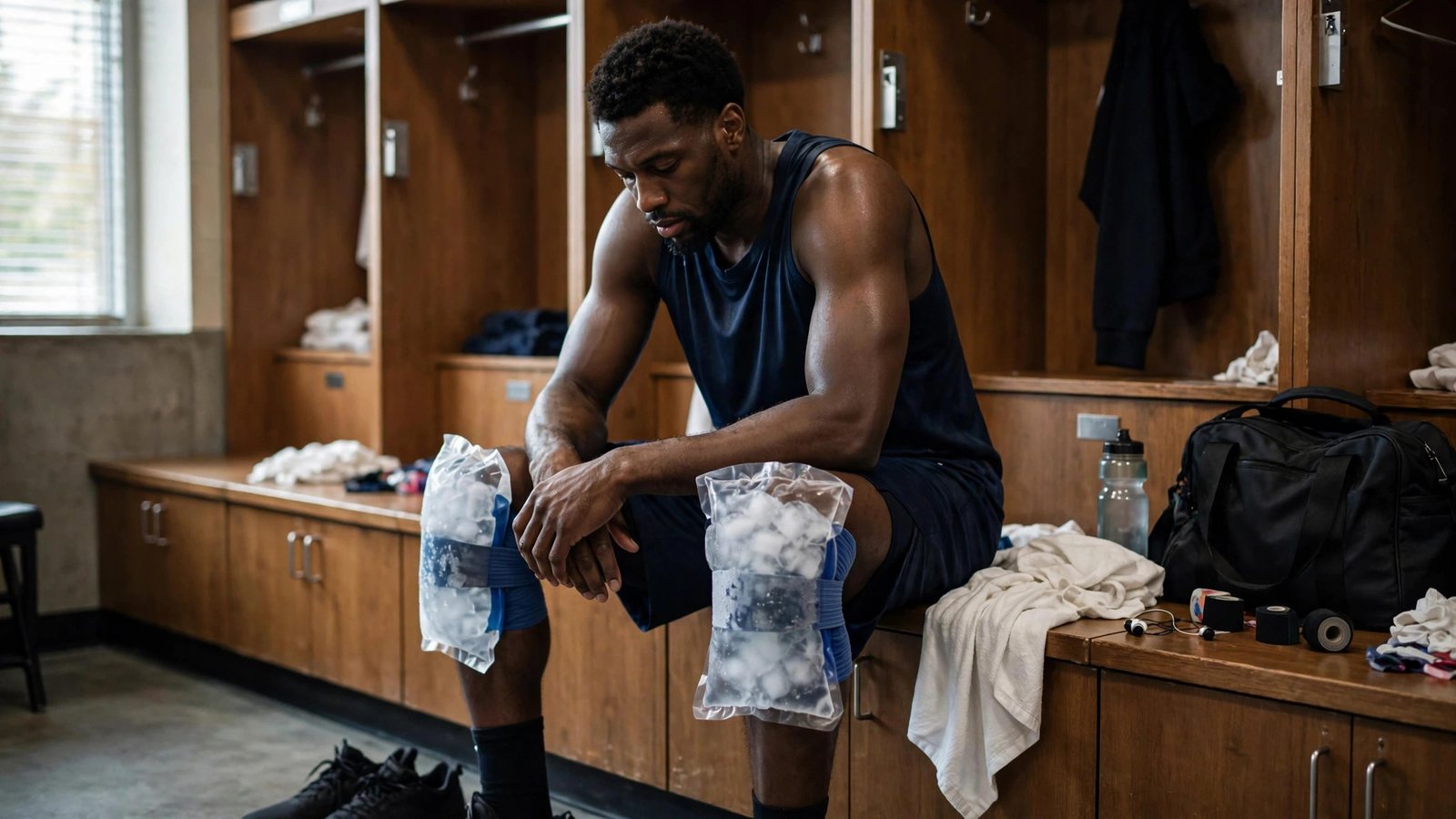
Watch any postgame locker room footage and you’ll see it: star athletes with ice bags strapped to both knees, sitting through interviews like it’s the most normal thing in the world. It is — icing knees after games is one of professional sports’ most universal rituals, practiced across the NBA, NFL, MLB, and NHL. But why? Is it science, superstition, or just something everyone’s always done? The answer is a mix of real physiology, genuine pain management, and a tradition that’s currently being re-examined by sports science. Here’s what’s actually happening under those ice bags.
The Core Reason: Controlling Inflammation and Swelling
A basketball game subjects knees to hundreds of jumps, cuts, and landings; a football game adds collisions; even baseball catchers destroy their knees in a crouch for three hours. This trauma triggers the body’s inflammatory response — blood flow rushes to the area, fluid accumulates, tissues swell. Some inflammation is the healing process starting, but excessive swelling causes pain, stiffness, and restricted range of motion that can linger for days.
Ice constricts blood vessels (vasoconstriction), which limits the fluid accumulation driving swelling. Applied within the post-game window, it measurably reduces edema and the pain that comes with it. For athletes playing 82-game NBA seasons or 17-game NFL schedules with short turnarounds, reducing next-day swelling isn’t cosmetic — it’s the difference between practicing tomorrow and missing two days. The Hospital for Special Surgery’s sports injury resources explain the physiology of post-exercise icing protocols.
Pain Management Without Pills
The second major benefit is analgesia — ice numbs. Cold reduces nerve conduction velocity, literally slowing pain signals from the knee to the brain, while also reducing muscle spasm around the joint. For athletes managing chronic knee tenderness across a long season, 15–20 minutes of icing after games provides meaningful pain relief without medication.
This matters more than it sounds in modern sports. With opioid awareness reshaping pain management and even NSAIDs (ibuprofen, etc.) under scrutiny for their effects on healing and gut/kidney health with chronic use, non-pharmacological pain control is valuable. Ice is free, has no systemic side effects, and can be applied in the locker room immediately. For the athlete icing “just because the knees are barking,” the mechanism is straightforward: cold numbs pain, and pain-free sleep after a game accelerates everything else about recovery.
The Science Debate: Does Ice Delay Healing?
Here’s where it gets interesting — and where the ritual faces legitimate challenge. The inflammatory response ice suppresses isn’t just a side effect; it’s the first phase of tissue repair. Inflammatory cells clean up damaged tissue and signal the rebuilding process. Some sports scientists argue that aggressively icing every minor inflammation may blunt the adaptation and healing response — the theory behind the recent shift from RICE (Rest, Ice, Compression, Elevation) to protocols like PEACE & LOVE, which de-emphasize routine icing.
The nuance: this debate concerns chronic over-icing of minor issues and soft-tissue healing. What athletes are doing post-game is different — managing acute swelling and pain from known heavy joint loading, not suppressing all inflammation indefinitely. Most team physicians land on a pragmatic middle ground: ice for pain and excessive swelling after games, but don’t ice everything prophylactically for hours, and don’t use ice as a substitute for addressing underlying issues. The ritual persists because, for its actual purposes — swelling control and pain relief after competition — it works.
The Practical Protocol (And the Ritual Element)
The standard pro protocol: 15–20 minutes of icing per knee within an hour after the game, often combined with compression (ice bags wrapped with elastic bandages) and elevation. Longer isn’t better — beyond 20 minutes, risks of skin and nerve irritation rise without added benefit. Many athletes ice in the locker room while doing media, treatment, or just decompressing — which reveals the ritual’s secondary function.
Don’t underestimate the psychological component. Post-game icing is routine, control, and transition — a physical signal that competition is over and recovery has begun. Athletes are creatures of habit, and the ice bags are as much a mental wind-down ritual as a physiological intervention. Sports psychologists note that consistent post-performance routines reduce anxiety and improve perceived recovery, which itself aids actual recovery. When you see the ice bags, you’re seeing sports science, pain management, and pre-sleep ritual in one frozen package. The National Institutes of Health’s sports medicine research continues to refine our understanding of cold therapy’s mechanisms and optimal use.
Should You Ice Your Knees Too?
For recreational athletes: ice after genuinely hard efforts that leave knees swollen or achy — long runs, intense pickup games, heavy leg days. The 15–20 minute protocol with a barrier (thin towel between ice and skin) works the same for you as for pros. Don’t ice minor everyday soreness out of habit; let normal adaptation happen. And ice is for acute management, not chronic problems — knees that hurt every day for weeks need evaluation (possible meniscus, arthritis, or tendon issues), not a freezer routine.
Alternatives and complements: compression sleeves during and after activity, elevation, gentle movement (walking, cycling) to pump swelling out, and proper strength work — strong quads and glutes protect knees more than any ice bag. The pros ice because their knees take professional-level punishment on professional schedules; your knees probably need the strength work more than the ice. But after that brutal Sunday league doubleheader? The ice bag is earned.
Pro athletes ice their knees after games to control inflammation-driven swelling and manage pain without medication — critical for playing again in days, not weeks. The 15–20 minute protocol constricts blood vessels, numbs pain, and doubles as a mental wind-down ritual. Sports science debates routine over-icing, but for acute post-game swelling and soreness, icing remains effective and universal.
Conclusion
Those post-game ice bags are equal parts physiology (swelling control), pharmacology (drug-free pain relief), and psychology (recovery ritual) — a practical response to the extraordinary joint punishment of professional sports. Recreational athletes can use the same 15–20 minute protocol after genuinely hard efforts, while remembering that consistent strength work protects knees more than any ice bag. Ice the acute damage; train against the chronic kind. For more sports recovery guidance, browse our sports section, meet our team, or ask your training questions.
Frequently Asked Questions
How long should you ice knees after sports?
15–20 minutes per area, with a thin barrier between ice and skin. Longer sessions risk skin and nerve irritation without added benefit. Ice within an hour after activity for maximum swelling control, often combined with compression and elevation.
Does icing actually help healing or just mask pain?
Both — it measurably reduces swelling (which aids function) and numbs pain. The debate is whether suppressing inflammation also blunts some healing signals; current consensus supports icing for acute post-game swelling and pain, while cautioning against excessive routine icing of minor issues.
Should I ice my knees after every workout?
No — reserve icing for genuinely hard efforts that produce swelling or significant achiness. Icing minor everyday soreness out of habit may interfere with normal adaptation. For routine recovery, movement, sleep, and strength work matter more.
Is ice or heat better for knee pain?
Ice for acute situations — after activity, with swelling, within 48–72 hours of a flare-up. Heat for chronic stiffness — arthritic morning stiffness, tight muscles before activity. Using heat on a freshly swollen knee worsens swelling; using ice on chronic stiffness just feels unpleasant.
Why do athletes ice even when they’re not injured?
Preventive swelling and pain management across grueling schedules — an NBA player can’t afford two days of stiff knees between games. It’s maintenance, not treatment: controlling the cumulative toll of professional workloads, plus the mental wind-down ritual of the post-game routine.
Leave a Reply