
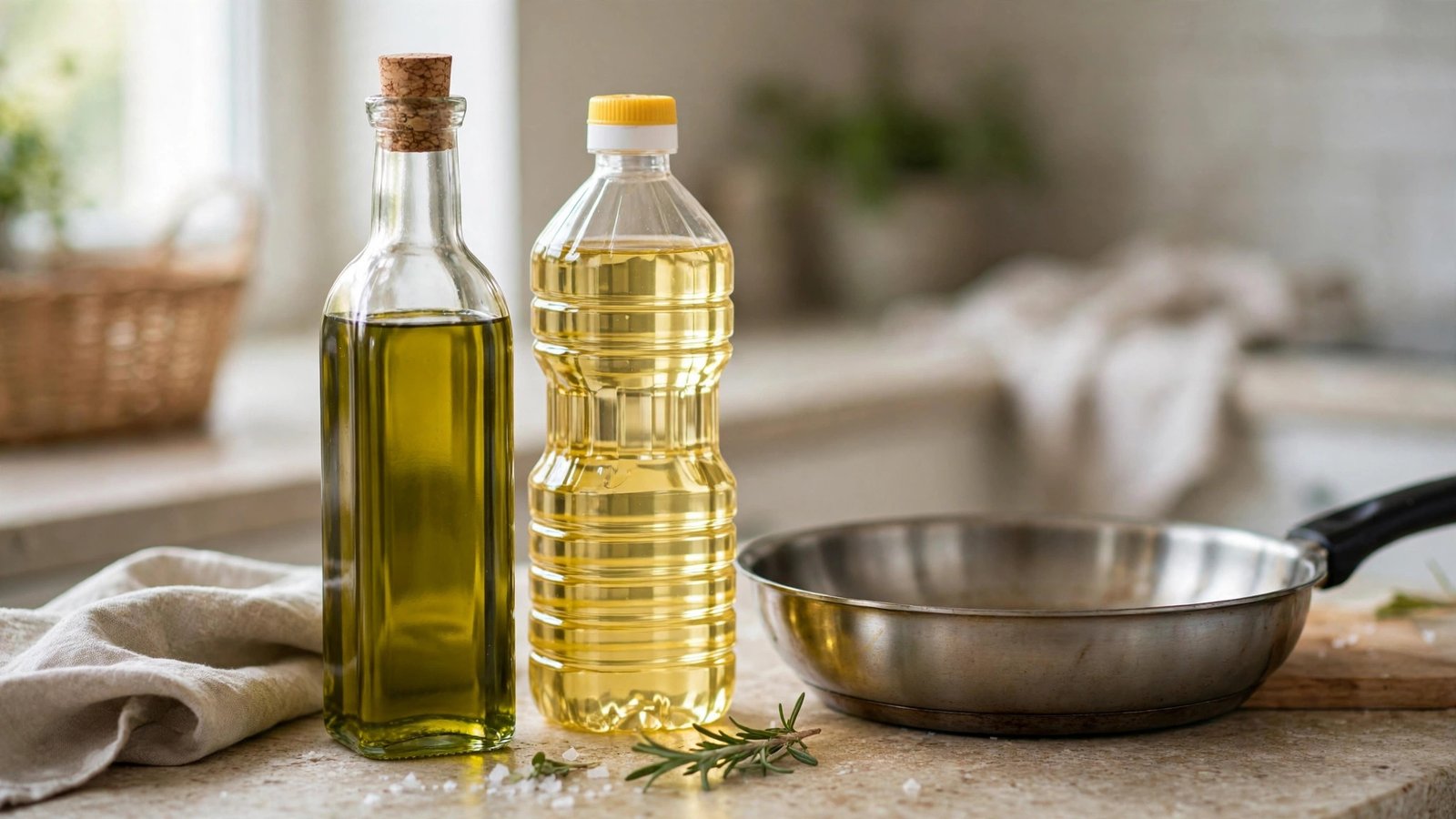
Two bottles by the stove, two very different jobs — but most home cooks reach for whichever is closest. Olive oil and vegetable oil are not interchangeable, and using the wrong one costs you in flavor, performance, or money. The choice comes down to three factors: how hot you are cooking, whether you want the oil’s flavor in the dish, and what you are willing to spend. Get these right and every single sauté, fry, and salad dressing improves. Here are the clear rules for when to use each.
Smoke Points: What They Mean and What They Do Not
Smoke point — the temperature where an oil starts visibly smoking — is the most quoted and most misunderstood oil fact. Refined vegetable oils (canola, soybean, generic “vegetable oil”) smoke around 400°F to 450°F. Extra-virgin olive oil smokes lower, roughly 375°F to 410°F depending on quality. Here is what the smoke point actually tells you: the temperature ceiling for clean cooking, beyond which flavor degrades and the oil breaks down. Here is what it does not tell you: that olive oil is “unsafe” at high heat. Recent research, including work reviewed by the UC Davis Olive Center, shows extra-virgin olive oil is remarkably stable at typical cooking temperatures thanks to its antioxidants — the old advice that it becomes toxic when heated is a myth. Still, for the hottest cooking, higher smoke points give more margin, which is where refined oils earn their place.
Deep Frying: Vegetable Oil Wins
For deep frying — french fries, fried chicken, tempura — refined vegetable oil (or peanut oil) is the clear choice, for three reasons. First, the high smoke point handles 350°F to 375°F frying with margin to spare. Second, the neutral flavor lets the food’s taste shine; frying delicate fish in robust extra-virgin olive oil would bulldoze it. Third, cost: deep frying needs quarts of oil, and good olive oil at that volume is extravagant. Peanut oil is the traditional restaurant fryer oil for its clean taste and high smoke point; canola and soybean work nearly as well for less money. Save the olive oil for applications where you will actually taste it — at frying temperatures and volumes, its flavor mostly cooks off anyway, so you are paying for nuance that heat destroys.
Sautéing and Everyday Cooking: Olive Oil’s Home Turf
For sautéing, pan-frying, and roasting at moderate temperatures — the vast majority of home cooking — olive oil is excellent. Most sautéing happens between 300°F and 375°F, comfortably within extra-virgin olive oil’s range, and its flavor genuinely improves vegetables, eggs, and proteins. Mediterranean cooking built entire cuisines on this principle. Use regular or “light” olive oil (more refined, higher smoke point, milder flavor) for higher-heat searing, and save the peppery, expensive extra-virgin for moderate heat where its character survives. The cooking oil testing at Serious Eats confirms that for typical stovetop temperatures, olive oil performs beautifully and the smoke-point anxiety is overblown. If your olive oil smokes the moment it hits the pan, your burner is simply too hot for what you are cooking.
Dressings, Dips, and Finishing: Always Olive Oil
Anywhere oil is tasted raw — salad dressings, dips, drizzles over soup, bread dipping — extra-virgin olive oil is non-negotiable. Its fruity, peppery complexity is the point of the dish; neutral vegetable oil contributes nothing but calories. This is where spending on good olive oil pays off most visibly: a $20 bottle of fresh, high-quality extra-virgin transforms a simple vinaigrette, while the same bottle wasted in a deep fryer is money burned. Finish cooked dishes with a thread of your best olive oil — over grilled vegetables, beans, or pasta — to add fresh flavor that cooking would have muted. Buy smaller bottles of the good stuff so it stays fresh; olive oil degrades with heat, light, and time. A simple homemade vinaigrette — three parts extra-virgin olive oil to one part vinegar, plus mustard, salt, and pepper shaken in a jar — will permanently retire the bottled dressing in your fridge door.
Refined vs. Extra-Virgin: Know What You Are Buying
“Olive oil” on a label covers a wide range. Extra-virgin is cold-pressed, unrefined, flavorful, and the healthiest choice — look for harvest dates and buy from the most recent harvest. “Light” or “pure” olive oil is refined: neutral, higher smoke point, cheaper, better for high heat. On the vegetable oil side, “vegetable oil” is usually soybean; canola is a specific, slightly healthier-feeling neutral oil; both are refined and interchangeable for frying. Avoid reusing frying oil too many times — strain it, store it dark and cool, and discard when it darkens, smells off, or smokes early. And store all oils away from the stove; heat and light are the enemies of freshness for every oil you own.
Use vegetable (or peanut) oil for deep frying — high smoke point, neutral flavor, affordable in volume. Use olive oil for sautéing, roasting, and everyday cooking up to medium-high heat, where its flavor improves the dish. Reserve good extra-virgin olive oil for dressings, dips, and finishing, where you taste it raw. The “olive oil is unsafe when heated” claim is a myth; match the oil to the heat and the flavor job.
Conclusion
The olive oil versus vegetable oil question resolves into simple rules: fry hot and neutral with vegetable oil, cook everyday meals with olive oil, and dress and finish with your best extra-virgin. Buy the good olive oil in small bottles, keep all oils cool and dark, and stop worrying about olive oil at sauté temperatures. More kitchen fundamentals? Browse our food guides, meet our team, or send us your questions.
Frequently Asked Questions
Is it bad to cook with extra-virgin olive oil at high heat?
No — this is a persistent myth. Research shows extra-virgin olive oil is quite stable at normal cooking temperatures due to its antioxidants. It smokes around 375-410°F, so for the very hottest searing, a refined oil gives more margin, but everyday sautéing is completely fine.
Can I mix olive oil and vegetable oil for frying?
You can, but there is little point — the blend takes on the lower smoke point and you lose the olive oil’s flavor to the heat anyway. For frying, just use the neutral oil; save the olive oil for where you will taste it.
What is the healthiest oil for frying?
For deep frying, peanut and high-oleic canola oils are good choices — stable at high heat with reasonable fat profiles. Olive oil’s health halo applies most to unheated uses; at frying temperatures and volumes, stability and smoke point matter more.
How should I store cooking oils?
Cool, dark, and sealed — a cabinet away from the stove, not the countertop next to it. Heat and light degrade all oils. Buy olive oil in quantities you will use within a few months, and check harvest dates on extra-virgin.
What is the difference between light and extra-virgin olive oil?
Extra-virgin is cold-pressed and unrefined, with full flavor and the most antioxidants. “Light” olive oil is refined — neutral in flavor with a higher smoke point. They are different tools: extra-virgin for flavor, light for high-heat cooking.
Leave a Reply