
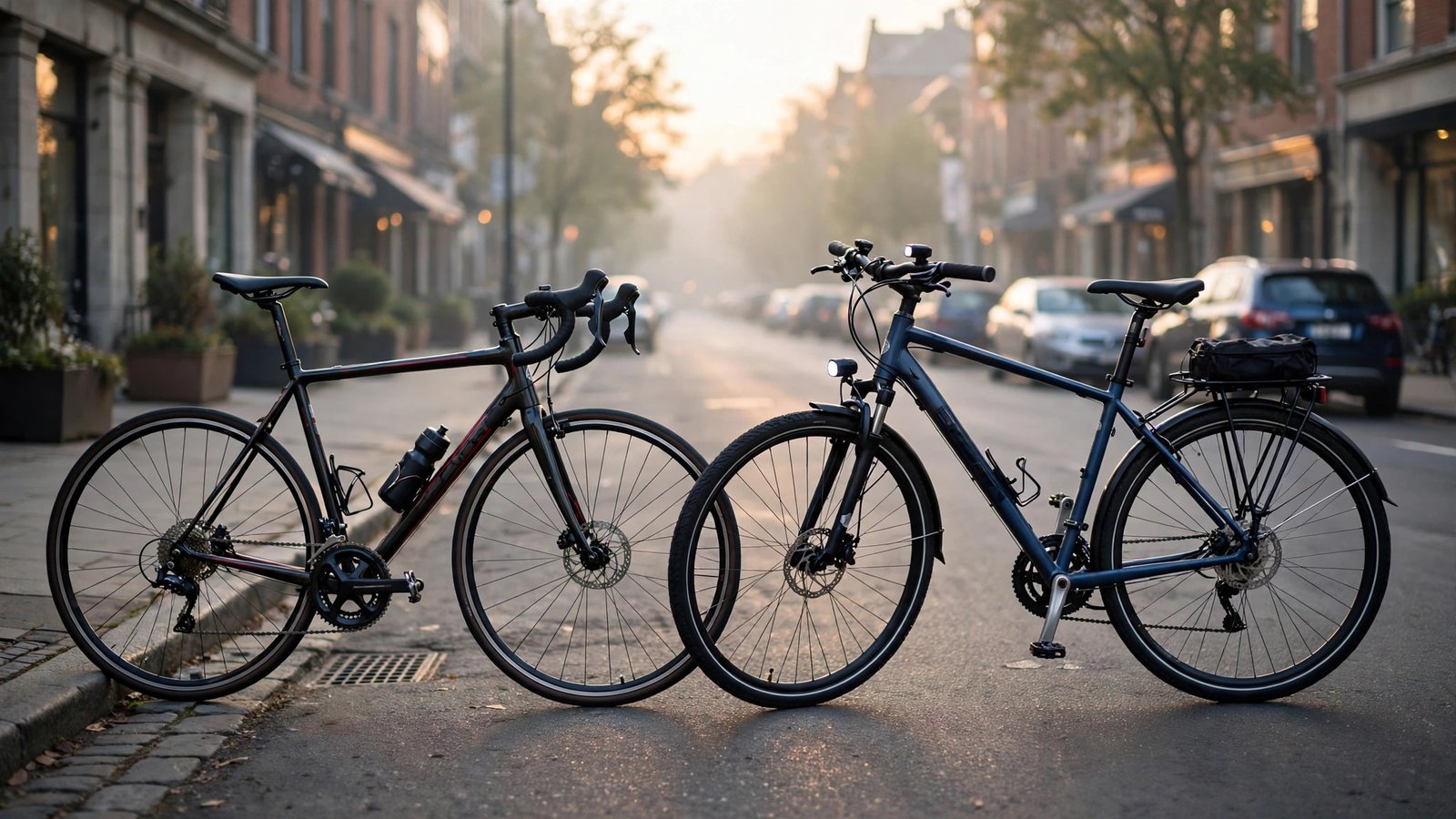
You want to bike to work, and the internet has opinions: the roadies say a hybrid is a slow compromise, the commuters say a road bike is a fragile diva that will strand you in the rain. Both are exaggerating. Road bikes and hybrids are genuinely different tools, and the right one for commuting depends on your route, your body, and how much fuss you are willing to tolerate before coffee. This guide cuts through the tribalism with the practical differences that actually matter on a Tuesday morning in traffic — geometry, tires, gears, carrying capacity, and durability — so you can buy once and ride happy for years.
Start With Your Route, Not the Bike
The single most important variable is the commute itself. Map it honestly: how many miles each way, how much is protected bike lane versus open road, how rough is the pavement, and how many hills stand between you and your desk? A five-mile ride on smooth pavement with bike lanes is a completely different problem from a twelve-mile mixed route with potholes, gravel shortcuts, and a 400-foot climb. Short, smooth, and flat favors the road bike’s speed; long, rough, or hill-heavy with cargo favors the hybrid’s comfort and toughness. Also consider the non-riding parts of commuting: do you have secure indoor parking, or will the bike live on a rack in the rain? Will you carry a laptop, lunch, and a change of clothes? A bike that cannot comfortably carry your stuff — or that you are afraid to lock outside — is the wrong commuter no matter how fast it is.
Geometry: The Comfort Gap Is Real
The core difference between the two is riding position. A road bike puts you in an aggressive, leaned-forward posture with drop handlebars: aerodynamic and efficient, but demanding on your back, neck, and wrists until your body adapts. A hybrid gives you a flat handlebar and a far more upright position — you see traffic better, your weight sits on the saddle rather than your hands, and you arrive less folded-up. For rides under 30 minutes, most commuters adapt to either. Beyond that, or if you have any back or neck issues, the hybrid’s upright geometry is meaningfully kinder. There is a middle ground worth knowing about: endurance road bikes and gravel bikes have relaxed geometry that splits the difference, and flat-bar road bikes exist too. But as categories go, hybrids win comfort for the average commuter, and that comfort is what determines whether you still ride in month six.
Tires and Durability: Where Hybrids Earn Their Keep
Commutes are not races; they are obstacle courses of potholes, debris, wet leaves, and the occasional curb. Hybrids typically roll on wider tires — 35 to 45 millimeters — that absorb rough pavement, resist pinch flats, and grip confidently in the rain. Road bikes traditionally run 23 to 28 millimeter tires at high pressure: faster on smooth asphalt, harsher and more puncture-prone everywhere else. Modern road bikes have moved toward wider rubber, which narrows the gap, but the hybrid’s sturdier wheels and more relaxed frame still shrug off abuse better. If your route includes any gravel, broken pavement, or winter riding, the hybrid’s toughness is not a luxury — it is the difference between a reliable daily tool and a bike that spends Fridays in the shop. Fenders and racks, the unsung heroes of commuting, also mount more easily and cheaply on most hybrids — see the League of American Bicyclists’ commuter resources for route-planning and gear checklists.
Speed: How Much Faster Is a Road Bike, Really?
Let us quantify the road bike’s advantage honestly. On flat, smooth pavement, a reasonably fit rider on a road bike cruises 2 to 4 mph faster than the same rider on a hybrid — the aerodynamics, lighter weight, and narrower tires all compound. Over a 30-minute commute, that is roughly five to eight minutes saved each way. That is real, but in stop-and-go city traffic the gap shrinks dramatically — aerodynamics barely matter at 12 mph between red lights. Hills are where the road bike’s lighter weight and more efficient gearing shine brightest. So ask yourself what your time is worth and what your route rewards. If you are chasing a sub-30-minute ten-miler on open roads, the road bike earns its keep. If your commute is a six-mile urban crawl, you will arrive within minutes of each other, and the hybrid rider will arrive more comfortable.
Gearing, Maintenance, and Cost of Ownership
Both bike types now come with wide-range gearing that handles real hills, so do not overthink the drivetrain — but do think about maintenance. Road bikes, especially performance-oriented ones, tend toward lighter components and tighter tolerances that demand more frequent tuning. Hybrids are generally built to be neglected a little: sturdier wheels, simpler components, and frames that tolerate a lock-up outside. Cost follows the same pattern: a solid commuter hybrid starts around $500 to $800, while a decent entry road bike starts around $900 to $1,200, and the road bike will tempt you into upgrades (clipless pedals, better wheels) that the hybrid never will. Budget for the accessories either way — a good lock, lights, fenders, and a rack or panniers will add $150 to $300 to either bike, and they matter more to commuting happiness than the frame does. PeopleForBikes’ city ratings show how bike-friendly your route actually is before you buy.
Match the bike to the route: smooth, longer, hillier commutes reward a road bike’s speed; rough, stop-and-go, cargo-carrying commutes reward a hybrid’s comfort and toughness. The best commuter bike is the one you’ll still happily ride in month six — comfort and practicality beat speed for almost everyone.
The Verdict: A Decision Framework
Choose the road bike if your commute is over eight miles each way on decent pavement, you are reasonably fit or want to get fit fast, you have secure indoor parking, and you might also ride for fun on weekends — a road bike that doubles as a weekend bike is excellent value. Choose the hybrid if your route has rough pavement or mixed surfaces, you carry cargo, you lock up outside, you have back or neck concerns, or you simply want the lowest-maintenance, most forgiving daily tool. Either way, test-ride both on a route that resembles your commute, not just around the parking lot — twenty minutes in the saddle tells you more than twenty reviews. And whatever you buy, get a professional basic fit; a $75 fit session prevents the knee pain and numb hands that kill more commuting habits than any bike choice.
Conclusion
Road bike versus hybrid is not a contest with a winner — it is a matching problem. Audit your route honestly, weigh speed against comfort and durability, budget for the accessories that make commuting actually work, and test-ride before you commit. Thousands of Americans have replaced car commutes with bikes that fit their real lives, and the right choice here is simply the one that gets ridden. For more practical gear and fitness guidance, check our sports section, read about the people behind these guides, or ask us your cycling question — we answer every one.
Frequently Asked Questions
Can I put drop handlebars on a hybrid later?
Technically possible but rarely worth it — the frame geometry, brake levers, and shifters are all designed around flat bars, so the conversion costs nearly as much as the bike. If you think you want drops eventually, buy the road bike (or a gravel bike) from the start.
Are e-bikes a better commuter option than either?
For hilly or long commutes, often yes — an e-hybrid flattens hills and kills sweat, which removes the two biggest barriers to daily riding. They cost more upfront ($1,500+) and weigh more, but for commutes over ten miles or with serious elevation, they are worth a serious look.
How much should I spend on my first commuter bike?
The sweet spot is $600 to $1,000 for a hybrid and $900 to $1,400 for a road bike, plus $150 to $300 for lock, lights, fenders, and cargo carrying. Below that range you get components that wear out fast; far above it you get performance you cannot use in traffic.
Do I need special clothes to commute by bike?
For rides under 20 minutes, no — regular clothes work fine, especially on an upright hybrid. Longer or hillier commutes merit padded shorts and a change of clothes at the office. The real essentials are visibility (lights and bright colors) and rain protection, not lycra.
What about a gravel bike instead of choosing between the two?
A gravel bike is genuinely the best of both for many commuters: drop-bar efficiency with wide, tough tires and relaxed geometry, plus rack and fender mounts. If your budget stretches to $1,000+, test-ride one — it may make this entire debate moot.
Leave a Reply