The Money of Liam Gallagher: A $60 Million Fortune Rebuilt by a Reunion
First, the Figure
Celebrity Net Worth estimates Liam Gallagher’s net worth at $60 million. The tracker’s own history shows how sharply that figure moved. It placed him near $6 million in mid-2024, before anyone announced an Oasis reunion, and its account also recalls the roughly $15 million fortune that his 2015 divorce proceedings disclosed. The Sunday Times Rich List, published on May 15, 2026, prints a different kind of number: £375 million for Liam Gallagher and Noel Gallagher combined. This report flags that figure as combined at every mention. It counts two men’s wealth together, and it never describes Liam’s fortune alone.
Celebrity Net Worth estimates that the reunion concerts, merchandise and related media generated around $125 million in pre-tax earnings for Liam. Earnings and net worth describe different things: the $125 million describes money the reunion generated before tax and costs, while the $60 million describes the tracker’s estimate of what he holds now. This report keeps the two numbers in their separate lanes.
The basis of the fortune stays simple. Liam Gallagher fronts Oasis, one of the biggest British bands of the 1990s, and his voice carries its catalog. Performance income, touring income and his share of the band’s earnings built his wealth across three decades, and the Live ’25 reunion tour rebuilt it after the lean solo years.
The Rise, Year by Year
1991 — Oasis Takes Shape
Gallagher joined a Manchester band called The Rain in 1991, and the group renamed itself Oasis after his older brother Noel joined as guitarist and principal songwriter. Noel’s songs and Liam’s voice formed the band’s core offer from the start, and Creation Records signed the group in 1993 after label boss Alan McGee caught a Glasgow set.
1994 — Definitely Maybe
Definitely Maybe arrived in August 1994 and entered the British chart at number one. “Live Forever” and “Supersonic” introduced Liam’s snarl to a national audience, and the album became the fastest-selling British debut of its era. Oasis had a record, a reputation and a frontman within a single year.
1995 — (What’s the Story) Morning Glory?
The second album, (What’s the Story) Morning Glory?, arrived in 1995 and sold in the tens of millions worldwide. “Wonderwall” and “Don’t Look Back in Anger” turned Oasis into a stadium band, and Liam’s voice fronted both songs. Readers tracking the songwriting half of the partnership can follow Noel Gallagher’s net worth profile, which covers the brother whose writing powered this run.
1996 — Knebworth
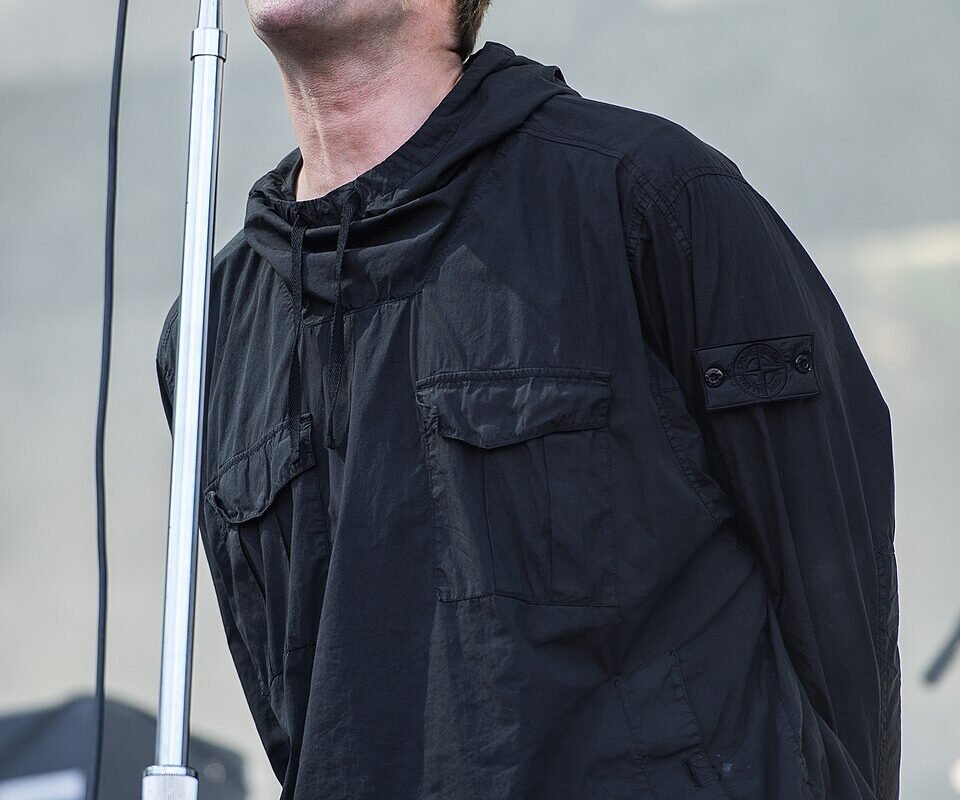
Oasis played two nights at Knebworth in August 1996 before roughly a quarter of a million people across the weekend, and promoters reported that millions more applied for tickets. The Knebworth concerts fixed the band’s scale in the public mind: no British group of the decade played bigger standalone shows. Liam fronted both nights, and the footage from those evenings still defines his performing image — still, centered, singing upward into the microphone.
1997 — Be Here Now
Be Here Now arrived in 1997 amid enormous expectation and sold at record speed in its first week. Reviews cooled on the album over time, but the tour confirmed Oasis at peak commercial power, and Liam’s earnings peaked with it.
2000–2008 — The Long Second Act
Oasis released four further studio albums across the 2000s: Standing on the Shoulder of Giants (2000), Heathen Chemistry (2002), Don’t Believe the Truth (2005) and Dig Out Your Soul (2008). Sales declined from the 1990s peak, but the band kept headlining stadiums and festivals, and the catalog kept earning. Liam also launched his Pretty Green clothing label in 2009.
2009 — The Split
Noel quit Oasis in August 2009, minutes before a Paris festival set, after a backstage fight between the brothers. The band ended that night. Liam formed Beady Eye with the remaining members, and Beady Eye released two albums, Different Gear, Still Speeding (2011) and BE (2013), before the group disbanded in 2014.
2017 — As You Were
Gallagher launched his solo career in 2017 with As You Were, and the album entered the British chart at number one. “Wall of Glass” led the singles, and the tour proved that Liam’s voice, without his brother’s band around it, still filled arenas. Solo income replaced the stalled band income, and the rebuild began.
2019 — Why Me? Why Not
His second solo album, Why Me? Why Not, topped the British chart in 2019. “Once” became a signature solo song, and Gallagher headlined festivals across the summer. The solo catalog now stood on its own, separate from the Oasis songbook that still paid him as its frontman.
2022 — C’mon You Know and Knebworth
C’mon You Know gave Gallagher a third solo number one in 2022, and he marked the year with two huge Knebworth concerts, returning to the site of Oasis’s most famous 1996 shows. The Knebworth dates underlined his drawing power a quarter-century after the originals.
2024 — Definitely Maybe at Thirty, Then the Announcement
Gallagher spent the summer of 2024 touring Definitely Maybe in full, thirty years after its release, and the arena run sold out on the strength of an album he recorded at twenty-one. The tour sharpened the question promoters had circled for years: if the songs drew this well with one brother, what would both brothers draw? Oasis announced reunion concerts in August 2024, ending a fifteen-year split. Tickets for the Live ’25 tour sold out in hours, and promoters added dates across several continents. The announcement alone reset Gallagher’s commercial value before a single note sounded.
2025 — Live ’25
The reunion tour played stadiums across 2025, and the brothers shared stages for the first time since 2009. Celebrity Net Worth estimates roughly $125 million in pre-tax earnings for Liam from the concerts, merchandise and related media — earnings, again, not net worth. The tour carried the brothers onto the Sunday Times Rich List together for the first time, at the combined £375 million figure this report flags throughout.
Beginnings
William John Paul Gallagher came into the world on September 21, 1972, in Longsight, Manchester. His parents, Thomas Gallagher and Margaret “Peggy” Gallagher, raised their sons in Burnage, a suburb of the city. Liam grew up the youngest of three boys: Paul, the eldest, and Noel, the middle son whose songwriting later defined the family business. Peggy left Thomas and took the boys with her after a marriage that the sons have described in interviews as violent, and she raised them largely on her own from that point.
Gallagher attended St Bernard’s Roman Catholic Primary School and the Barlow Roman Catholic High School in Didsbury. He left education with little interest in qualifications and drifted through local jobs while Manchester’s music scene exploded around him. The Stone Roses and the city’s club culture pulled him toward music; a school friend, Paul “Guigsy” McGuigan, invited him to sing in The Rain, and the invitation changed the family’s fortunes permanently.
His working life before the band reads like a tour of early-nineties Manchester casual labor — a stint with British Gas among the jobs he has listed in interviews. Music offered the only exit he wanted. He has said that seeing the Stone Roses convinced him a local singer could front a major band, and his whole performing style — the stance, the clipped phrasing, the refusal to dance or work the crowd in the conventional sense — grew out of that Manchester scene rather than any formal training. Noel’s arrival in The Rain brought the songs; Liam already had the voice and the stare.
The Private Side
Gallagher’s partner is Debbie Gwyther, a music manager who has worked with him since 2014. The couple announced their engagement in 2019, and no report records a marriage; this report describes Gwyther as his partner and nothing more. She manages his solo career, and people around the camp credit her steady hand for the disciplined operation behind the solo albums and the reunion.
His earlier marriages form part of the record. He married Patsy Kensit in 1997, and the marriage ended in 2000. He married Nicole Appleton in 2008, and that marriage ended in divorce in 2014; the proceedings later disclosed a fortune near $15 million, the figure Celebrity Net Worth still cites as his mid-2010s position.
Gallagher counts four children. Molly arrived in 1998, Lennon in 1999, Gene in 2001 and Gemma in 2013. Lennon and Gene have both worked as models and musicians in their own right, and Molly’s son, born in 2025, made Gallagher a grandfather. His parents and brothers complete the family picture: Thomas and Peggy Gallagher; Paul, who works outside music; and Noel, whose partnership and long feud with Liam shaped the band’s entire public story. The feud ended, at least professionally, with the reunion — the two men now share stages, a Rich List entry and the combined figure that comes with it.
The Reporting Record
| The Reporting Record | Details |
|---|---|
| Born | September 21, 1972, Longsight, Manchester, England |
| Age | 54 |
| Height | 5 ft 10 in |
| Weight | No reliable published figure exists |
| Net Worth | $60 million (Celebrity Net Worth); the Sunday Times Rich List 2026 prints £375 million combined for Liam and Noel Gallagher |
| Birthday | September 21 |
| Partner | Debbie Gwyther (together since 2014; engaged 2019; no marriage reported) |
| Children | Four — Molly (1998), Lennon (1999), Gene (2001), Gemma (2013) |
| Parents | Thomas Gallagher and Margaret “Peggy” Gallagher |
| Family | Manchester family; partner Debbie Gwyther; four children; one grandchild (b. 2025) |
| Siblings | Older brothers Paul Gallagher and Noel Gallagher |
| Songs | “Live Forever”, “Wonderwall”, “Champagne Supernova” (with Oasis); “Wall of Glass”, “Once” (solo) |
| Albums | With Oasis: Definitely Maybe (1994), (What’s the Story) Morning Glory? (1995), Be Here Now (1997); solo: As You Were (2017), Why Me? Why Not (2019), C’mon You Know (2022) |
| @liamgallagher |
What It All Adds Up To
Liam Gallagher’s $60 million describes a fortune that collapsed and recovered in public. The 1990s built it, the split and a costly divorce shrank it toward the $15 million the courts disclosed and the $6 million the tracker printed in 2024, and the reunion rebuilt it in a single touring year. The £375 million Sunday Times figure belongs to both brothers together, and any account that hands it to Liam alone misreads the list.
At 54, Gallagher holds the strongest commercial position of his solo life. His voice fronts a catalog that stadiums still pay to hear, his three solo albums all topped the British chart, and the reunion converted nostalgia into the largest earnings year of his career. The tracker figure will move with whatever Oasis does next; the direction, for the first time in fifteen years, points up.
The Pretty Green label deserves a footnote in the money story. Gallagher launched the clothing brand in 2009, it traded through the solo wilderness years, and it gave him a business identity outside music while the band lay dormant. It never rivaled the music income, and this report counts no valuation for it, but it shows a frontman who understood early that a name can sell more than records. Between the label, the solo albums and the reunion, the second half of his career looks less like a decline and more like a long, uneven rebuild that the Live ’25 tour finally completed.
Filed under: Net Worth