
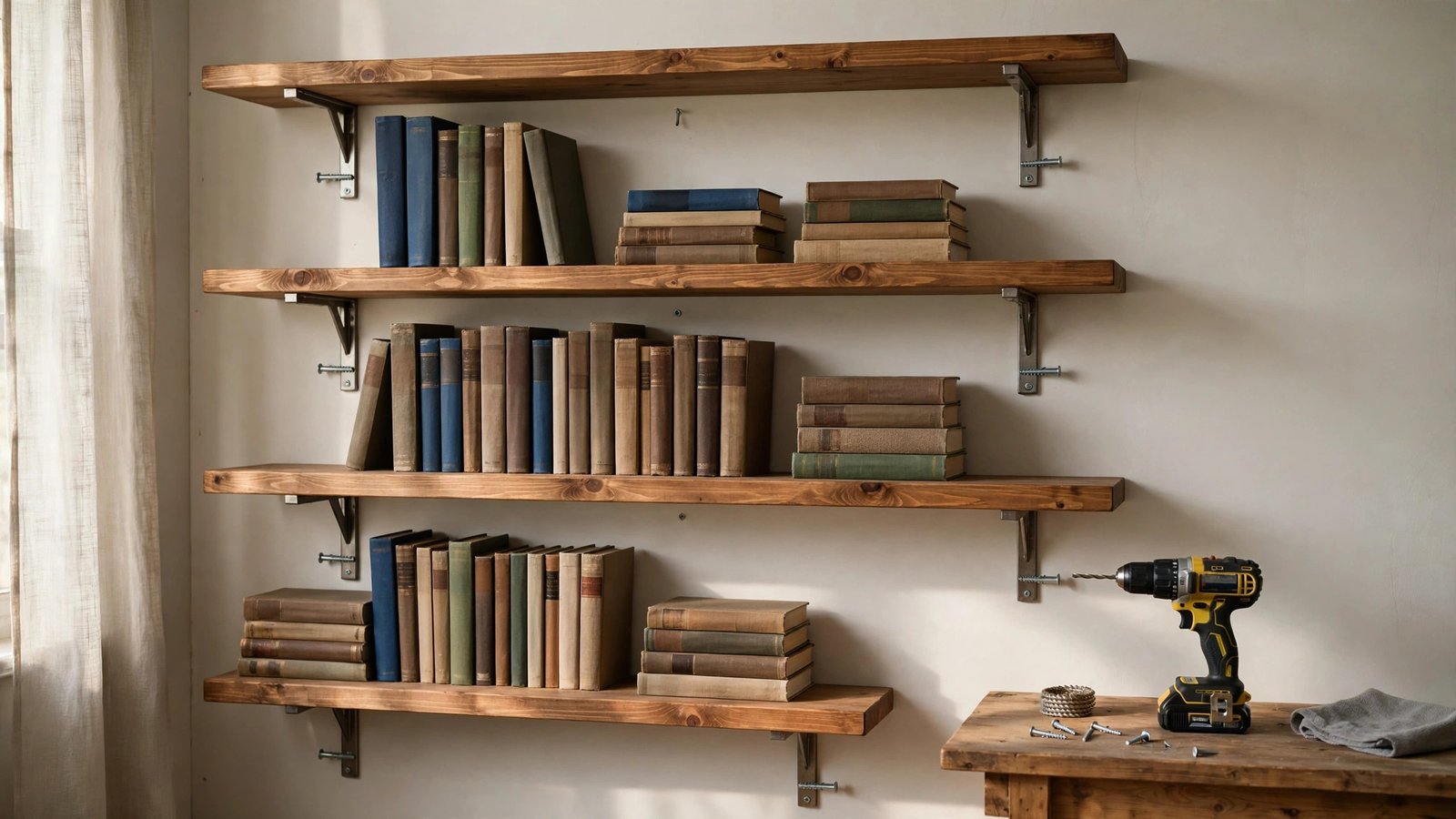
You found the perfect spot for shelves — and the stud finder says there are no studs there. Or the studs are 24 inches apart instead of 16, right where your brackets need to go. Hanging heavy shelves on drywall without studs feels like tempting fate, but it is entirely doable with the right anchors. Drywall itself is weak — a screw driven into bare drywall holds maybe 10 pounds before pulling out. But heavy-duty drywall anchors redistribute the load across a much larger area of the wall, and the best of them hold 50 to 100+ pounds each in 1/2-inch drywall. The trick is matching the anchor to the weight and installing it correctly. Here is the complete guide.
Know Your Real Weight First
Before choosing anchors, calculate honestly. A 4-foot wooden shelf weighs 10 to 20 pounds empty. Add books: a 4-foot shelf of hardcovers easily holds 40 to 60 pounds. Add decor, and a “heavy” shelf setup runs 60 to 100+ pounds per shelf. Now apply the safety factor: anchors should be rated for at least 2 to 3 times the expected load, because ratings assume perfect installation in perfect drywall — and your drywall may be 3/8-inch, moisture-softened, or previously patched. So a 60-pound loaded shelf needs anchors rated for 120 to 180 pounds total across the brackets. Count brackets too: two brackets sharing the load is standard; three brackets for shelves over 4 feet. Write down the number before shopping — anchor packages list their ratings, and guessing at the store leads to under-spec’d hardware. The accessibility and safety standards aside, the physics here is simple: the wall fails when the anchor’s grip area is overloaded, so bigger grip area equals more weight.
The Anchor Hierarchy: From Light to Heavy-Duty
Not all drywall anchors are remotely equal. Ranked by holding power in 1/2-inch drywall: plastic expansion anchors (the cheap ones in furniture kits) — 10 to 25 lbs each; adequate for small decor shelves, useless for books. Self-drilling threaded anchors (E-Z Ancor style) — 25 to 50 lbs each; good for medium shelves, easy install with just a screwdriver. Toggle bolts (spring-wing) — 50 to 100+ lbs each; the classic heavy-duty choice, requiring a larger hole but gripping a wide area behind the drywall. Snap-toggle / strap-toggle bolts (Toggler brand) — 80 to 150+ lbs each in 1/2-inch drywall; the professional’s choice — a metal channel lies flat behind the wall distributing load broadly, the bolt is removable and reusable, and the hole is smaller than old-style toggles. Molly bolts (sleeve-type) — 25 to 50 lbs; decent but fiddly. For heavy shelves (books, dishes, equipment): snap-toggles are the answer, full stop. They cost $1 to $2 each, install with a screwdriver and a 1/2-inch drill bit, and hold more than any shelf will ever need when used in pairs per bracket.
Installation: The Details That Determine Success
Anchor failure is almost always installation failure. Drill the hole to the exact specified size — too small and the anchor will not seat; too large and it spins uselessly (the number-one cause of anchor failure). For snap-toggles: drill 1/2-inch, fold the metal channel flat, push through, pull the straps until the channel lies flat against the wall’s back face, slide the plastic cap flush, snap off the straps, then drive the bolt through your bracket into the channel. Critical: the bracket must sit flat against the wall — any gap between bracket and wall creates leverage that multiplies the pull-out force dramatically. Tighten firmly but do not overtighten and crush the drywall. Space anchors at least 2 inches from drywall edges and seams, where the board is weakest. And if you hit something solid while drilling — stop. You may have found a stud (great — drive a wood screw), a fire block, or a pipe (very bad — investigate before proceeding). The Family Handyman’s anchor installation guides show each type’s technique with photos worth reviewing before you drill.
Bracket and Shelf Design for Stud-Free Mounting
Anchors are half the equation; the shelf system is the other half. Use brackets with at least two anchor points each (vertical pairs resist the rotational pull-out force far better than single anchors). Deeper shelves create more leverage — a 12-inch-deep shelf loaded at the front edge exerts far more pull on the top anchor than a 8-inch shelf; keep heavy items toward the wall. Floating shelves (hidden brackets) look clean but concentrate enormous force on few anchor points — for heavy loads without studs, visible L-brackets or a French cleat system distributes weight better. A French cleat (a beveled strip screwed to the wall with multiple snap-toggles, shelf hanging on the bevel) is arguably the strongest stud-free shelf system: the load spreads across many anchors along the wall’s length. Whatever the design, load the shelf gradually and check for any wall flex or anchor movement in the first week — creeping failure shows as slowly widening gaps before it becomes sudden.
When You Really Need a Stud
Be honest about the limits. If the total loaded weight exceeds 150 pounds, if the drywall is damaged, thin (3/8-inch), or moisture-compromised, or if the shelf holds irreplaceable valuables above a child’s bed — find the studs or open the wall and add blocking. Stud finders miss studs more often than people think: scan slowly, mark edges from both directions, and confirm with a finish nail probe (tiny hole, easily filled) before giving up on studs. In apartments where you cannot open walls, a plywood backer board (3/4-inch plywood, 4 feet wide, anchored with six to eight snap-toggles) creates an artificial stud surface — mount anything to the plywood with wood screws afterward. It is the pro renter’s solution for genuinely heavy loads: the board distributes weight across a huge wall area, and it comes down with only small anchor holes to patch.
Hang heavy shelves on drywall without studs using snap-toggle bolts (80–150+ lbs each in 1/2″ drywall) — two per bracket, brackets flat against the wall, anchors rated for 2–3x the loaded shelf weight. Drill exact-size holes, keep heavy items toward the wall, and use a plywood backer board for loads over 150 lbs or compromised drywall.
Conclusion
Heavy shelves on stud-free drywall are a solved problem: calculate the real loaded weight, choose snap-toggle anchors rated well above it, install them with exact-size holes and flush brackets, and design the shelf to minimize leverage. Respect the limits — damaged drywall and extreme loads need studs or a backer board. Done right, your books will sit securely for years on a wall the stud finder said was empty. For more wall-mounting and DIY guides, browse our home improvement section, meet the team, or send us your questions.
Frequently Asked Questions
How much weight can drywall hold without a stud?
Bare drywall with a plain screw: ~10 lbs. With snap-toggle bolts in 1/2″ drywall: 80–150+ lbs per anchor. A shelf on two brackets with two snap-toggles each can safely hold 100+ lbs of books — provided the drywall is intact and anchors are installed correctly.
What is the strongest drywall anchor?
Snap-toggle (strap-toggle) bolts are the strongest common choice — 80–150+ lbs each in 1/2″ drywall, with a wide metal channel distributing load behind the wall. They outperform plastic anchors, self-drilling anchors, and traditional spring toggles, and the bolts are removable and reusable.
Can I hang a bookshelf on drywall with no studs?
Yes, with snap-toggle anchors: use brackets with two anchor points each, rate anchors for 2–3x the loaded weight (books are heavy — 40–60 lbs per 4-foot shelf), keep the brackets flush to the wall, and place heavy books toward the wall to reduce leverage.
Why do my drywall anchors keep spinning?
The hole is too large, the drywall is damaged or too thin at that spot, or you are using the wrong anchor type for the hole. Drill the exact specified size, avoid edges and seams, and switch to snap-toggles if plastic or self-drilling anchors will not grip.
Should I just open the wall and add blocking instead?
For loads over 150 lbs, damaged drywall, or shelves above beds holding valuables — yes, blocking between studs is the gold standard. For typical heavy shelves on intact drywall, properly installed snap-toggles are entirely sufficient and far less work.
Leave a Reply