
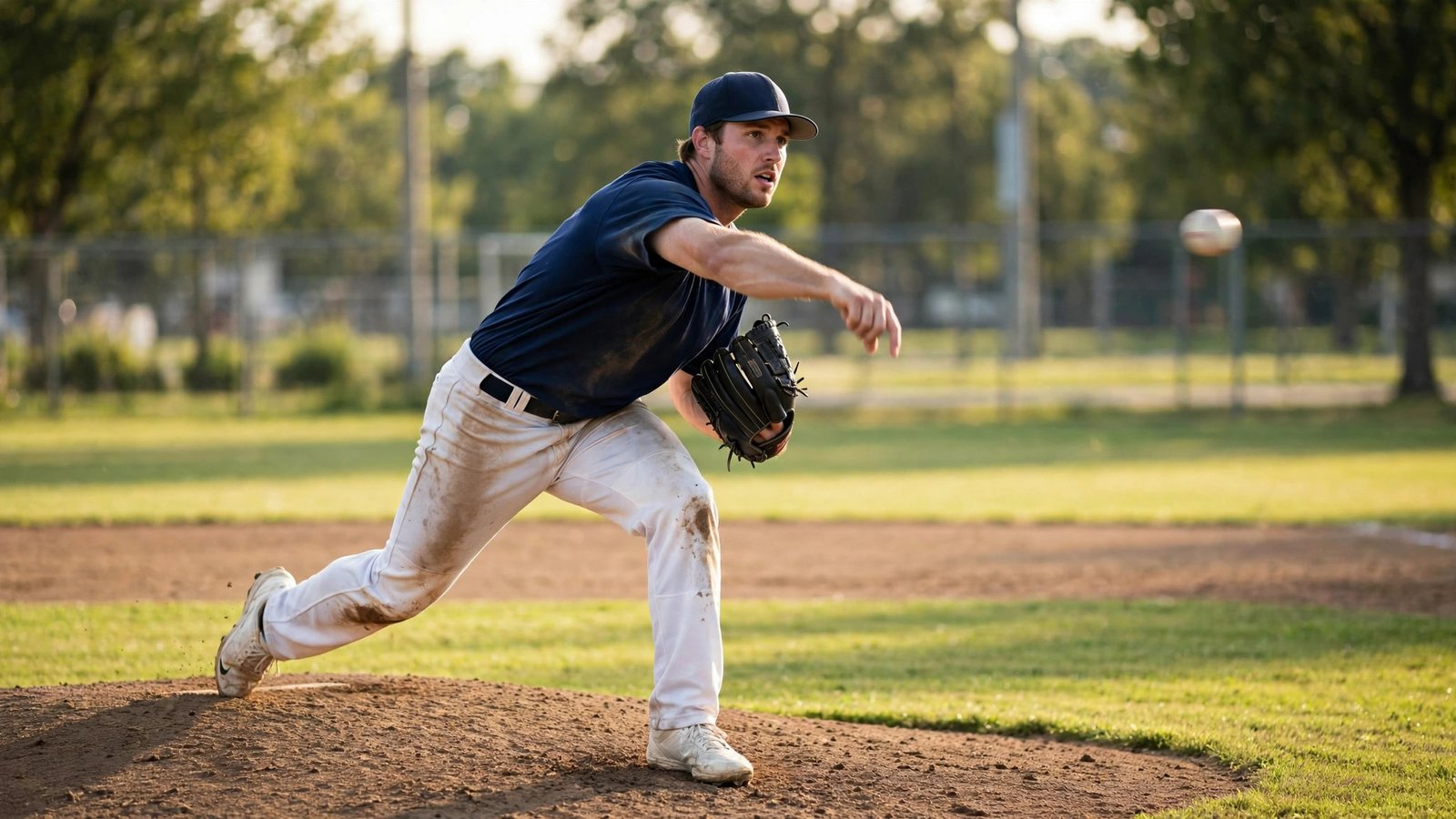
You’re warming up, you uncork a throw, and there it is — a distinct click or pop deep in your shoulder. It doesn’t exactly hurt, but it’s unsettling, and now you’re wondering if every throw is grinding something down in there. Shoulder clicking during throwing is one of the most common concerns in baseball, and the reassuring news is that painless clicking is usually harmless. But “usually” isn’t “always” — certain types of clicks signal real problems. Here’s how to tell the difference.
Why Shoulders Click: The Benign Explanations
Most painless shoulder clicking comes from normal mechanical phenomena. Cavitation: gas bubbles in the joint fluid popping under pressure changes — the same physics as cracking knuckles, completely harmless. Tendon movement: the biceps tendon or rotator cuff tendons sliding over bony prominences during the throwing motion’s extreme range — audible but not damaging when painless. Scapular movement: the shoulder blade gliding over the ribcage (scapulothoracic crepitus) produces grinding or clicking sensations, especially with muscle imbalances.
You can browse more features and updates from UK Big Breaking News’ latest updates.
The key diagnostic question is pain. Painless clicking that doesn’t affect your throwing — same velocity, same accuracy, no soreness afterward — is overwhelmingly benign. Millions of throwers click; orthopedists consider painless crepitus a normal variant, not a pathology. If your shoulder clicks but performs perfectly and feels fine, the click is almost certainly just noise. The American Academy of Orthopaedic Surgeons’ shoulder guide distinguishes benign joint sounds from symptoms needing evaluation.
When Clicking Signals a Real Problem
Certain click patterns warrant attention. Clicking with pain — especially sharp, catching pain during the throw — is the primary red flag. A feeling of instability or the shoulder “slipping” suggests labral issues or laxity. Clicking with weakness — velocity drop, inability to raise the arm fully afterward, dead-arm sensation — points toward rotator cuff involvement. Night pain or pain reaching behind your back are classic rotator cuff symptoms that sometimes start as “just clicking.”
Specific conditions behind problematic clicking: SLAP tears (labrum damage at the biceps attachment, common in throwers — clicking plus deep pain), rotator cuff tendinopathy or partial tears (clicking with weakness and painful arc), and internal impingement (the rotator cuff pinching in the extreme cocked-back throwing position). These don’t resolve with rest alone and need proper diagnosis — playing through them risks turning a manageable issue into a surgical one.
The Usual Culprit: Mechanics and Muscle Balance
For throwers whose clicking comes with mild soreness but no sharp pain, the cause is usually functional rather than structural: poor scapular control, weak rotator cuff, or throwing mechanics that stress the joint. The shoulder blade is the platform every throw launches from — when the scapular stabilizers (serratus anterior, lower trapezius) are weak, the shoulder mechanics go awry, tendons track poorly, and clicking with achiness results. This pattern, sometimes called scapular dyskinesis, is extremely common in throwers and very fixable.
The corrective program: scapular stabilization exercises (wall slides, serratus punches, prone Y-T-W raises), rotator cuff strengthening with light bands (external rotations, the thrower’s essential exercise), and thoracic spine mobility work (the mid-back stiffness that forces the shoulder to overwork). Two to three sessions weekly for a month typically quiets functional clicking significantly. A physical therapist can assess your specific pattern in one visit — worth it for any thrower with persistent symptoms. The Hospital for Special Surgery’s shoulder resources detail thrower-specific rehab protocols.
Throwing Mechanics That Click (And How to Fix Them)
Sometimes the click is a mechanics problem wearing a medical costume. Common culprits: opening the front shoulder early (forces the throwing shoulder into impingement range), insufficient trunk rotation (the arm tries to generate velocity the body should provide), and overthrowing — muscling the ball with the arm instead of driving with the legs and hips. Each increases shoulder stress and the odd sensations that come with it.
The fixes are fundamental, not exotic: long-toss programs that build arm strength gradually through distance rather than max-effort short throws, proper warmup (bands, progressive throwing distances — never max effort cold), and pitch/throw counts appropriate to your age and level. Coaches who understand throwing mechanics can spot these faults in minutes. And the eternal rule: pain changes everything — a mechanical adjustment is for painless clicking; painful clicking needs medical evaluation first, mechanical work second.
Getting Evaluated: What to Expect
If your clicking comes with pain, weakness, or instability, see a sports medicine physician or orthopedist — ideally one experienced with overhead athletes. Expect a physical exam with specific provocative tests (O’Brien’s, apprehension tests), and likely imaging: X-ray to rule out bony issues, MRI (possibly with contrast dye injected into the joint, called MR arthrogram) to visualize labrum and cuff. These precisely identify what’s clicking and why.
Most diagnoses lead to physical therapy first — surgery is the last resort, reserved for confirmed structural tears that fail conservative care. Be wary of anyone recommending surgery based on imaging alone without correlating to your symptoms; many throwers have labral “abnormalities” on MRI that are asymptomatic adaptations to throwing. Treat the patient, not the picture — a good sports physician knows the difference.
A painless shoulder click when throwing is usually harmless — joint cavitation, tendon movement, or scapular gliding — and needs no treatment if performance is unaffected. See a doctor for clicking with sharp pain, weakness, instability, or night pain, which can signal labral tears or rotator cuff issues. For achy-but-functional clicking, scapular stabilization exercises and mechanical fixes usually quiet it within weeks.
Conclusion
Your clicking shoulder is most likely just noisy, not broken — painless clicks in a well-performing arm are normal joint sounds. Strengthen the scapular stabilizers and rotator cuff, clean up throwing mechanics, warm up properly, and monitor for the red flags (pain, weakness, instability) that merit medical evaluation. Respect the warning signs, but don’t let a harmless click steal your confidence on the mound. For more throwing-arm guidance, browse our sports section, meet our team, or ask your training questions.
Frequently Asked Questions
Is it normal for my shoulder to click when throwing?
Yes — painless clicking is extremely common in throwers and usually comes from harmless joint cavitation, tendon movement, or scapular gliding. If there’s no pain, no weakness, and no performance loss, it’s considered a normal variant, not an injury.
When should shoulder clicking see a doctor?
See a sports medicine physician for clicking accompanied by sharp or catching pain, weakness, a feeling of instability, dead-arm sensation, or night pain. These patterns can indicate labral tears, rotator cuff issues, or impingement needing proper diagnosis.
Can exercises stop shoulder clicking?
Often, when the clicking comes with mild achiness from muscle imbalance. Scapular stabilization (wall slides, Y-T-W raises), rotator cuff band work, and thoracic mobility exercises typically reduce functional clicking within 3–4 weeks. Purely painless clicking may persist harmlessly regardless.
Does clicking mean I have a torn labrum?
Not necessarily — most painless clicking isn’t a labral tear. SLAP tears typically cause deep pain, catching sensations, and performance loss alongside the click. Only imaging correlated with symptoms can confirm a labral tear; don’t self-diagnose from the sound alone.
Should I stop throwing if my shoulder clicks?
Not for painless clicking with normal performance — just maintain good warmup, mechanics, and shoulder care exercises. Stop and get evaluated if clicking comes with pain, weakness, or instability. Playing through painful clicking risks worsening real structural problems.
Leave a Reply