
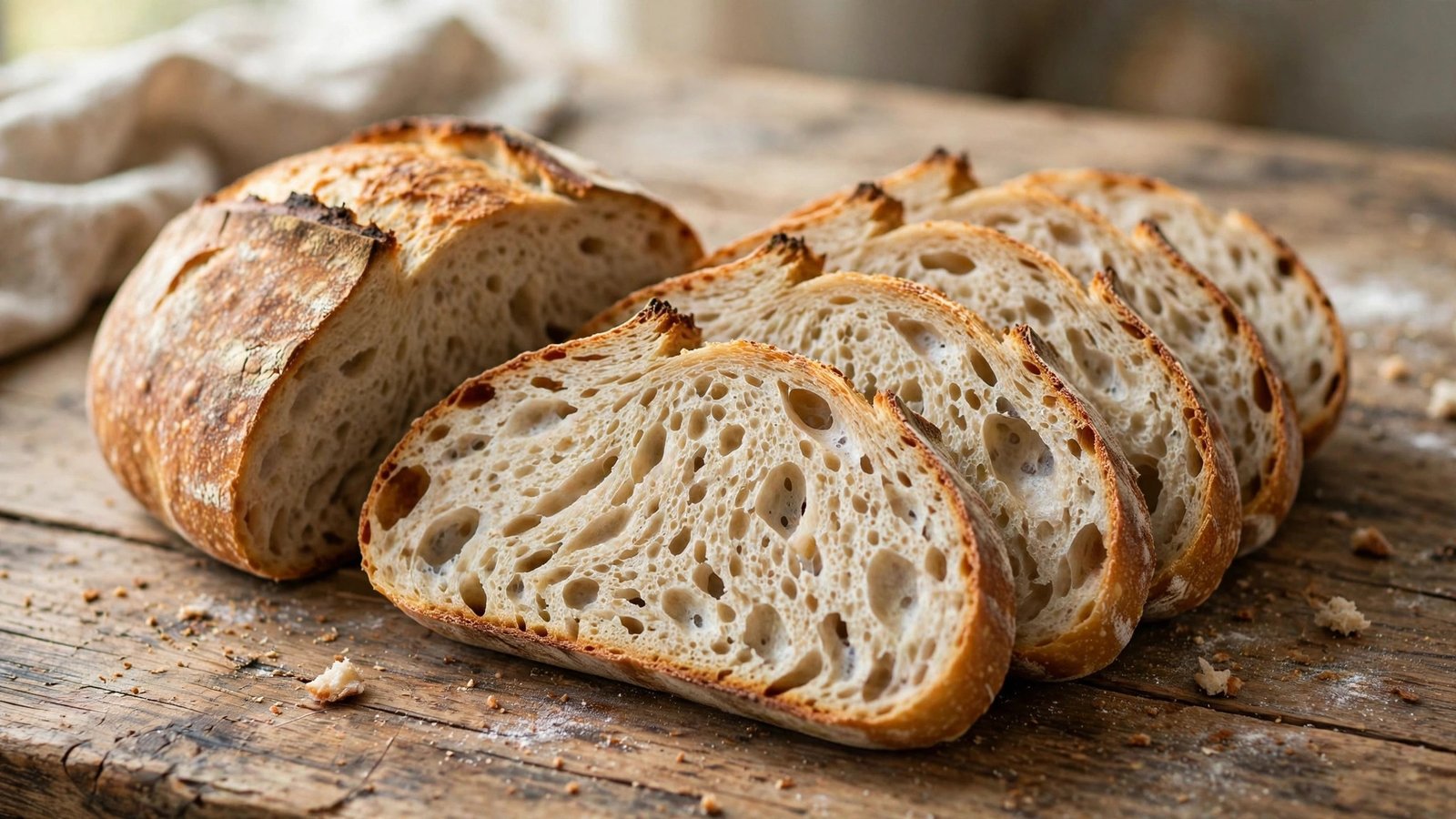
You waited twelve hours, the crust looks gorgeous, you cut in — and the inside is dense, damp, and gummy instead of open and airy. Dense, gummy sourdough is the most common frustration in home bread baking, and it almost always traces back to fermentation: either the dough did not ferment enough, or the starter was not strong enough to ferment it. The good news is that every cause has a clear fix, and learning to read your dough is a skill that transfers to every loaf you bake afterward. Here is how to diagnose and fix dense, gummy sourdough.
Cause #1: Under-Fermentation (The Usual Suspect)
Under-fermented dough is the number one cause of dense, gummy crumb. During bulk fermentation, the starter’s yeast and bacteria produce the gas that opens the crumb and the acids that develop flavor and structure. Cut this phase short and the loaf never builds enough gas — it bakes up dense — and the starches never properly transform, leaving that gummy, almost raw texture. The fix is learning to read the dough instead of the clock: properly fermented dough has grown 30 to 50 percent in volume, feels airy and alive, shows bubbles on the surface and sides, and jiggles like jelly when you nudge the bowl. In a cool kitchen (below 70°F), bulk fermentation can take 6 to 8 hours or more; in a warm kitchen, 3 to 4. Find a warm spot — inside the oven with the light on is the classic trick — and give the dough the time it actually needs. The sourdough guides from King Arthur Baking show exactly what properly fermented dough looks and feels like at each stage.
Cause #2: A Weak or Immature Starter
No amount of patience fixes a starter that is not ready. A healthy starter reliably doubles (or more) within 4 to 8 hours of feeding at room temperature, smells pleasantly tangy, and passes the float test — a spoonful dropped in water floats. If your starter is sluggish, young (under two weeks old), or has been languishing in the fridge unfed for a month, it cannot leaven a full loaf no matter how long you wait. Revive it with several days of twice-daily feedings at room temperature using a 1:2:2 or 1:3:3 ratio (starter:flour:water by weight) until it doubles predictably. Use it at peak — when it has just reached maximum rise, before it starts to fall and get soupy. Baking with a starter past its peak is a classic cause of dense loaves: the yeast is exhausted and the excess acid degrades the gluten.
Cause #3: Poor Gluten Development and Shaping
Even well-fermented dough bakes dense if the gluten network cannot trap gas. Under-mixed or under-folded dough lacks the elastic structure that holds bubbles; the gas escapes and the loaf stays flat. During bulk fermentation, perform a series of gentle stretch-and-folds every 30 to 45 minutes for the first two hours — this builds strength without degassing. The dough should progress from shaggy to smooth and elastic. Shaping matters too: a tight, confident shape creates surface tension that helps the loaf hold its form and rise upward instead of spreading. If your loaves consistently spread into pancakes, practice shaping — it is a physical skill that improves fast with repetition. Conversely, do not over-handle at the end; rough shaping after the dough is fully proofed knocks out the gas you spent hours building.
Cause #4: Underbaking and Cutting Too Soon
A loaf pulled too early finishes gummy because the interior starches never fully set. Sourdough needs a thorough bake: typically 20 minutes covered (for steam) plus 20 to 25 minutes uncovered at 450°F to 500°F, until the crust is deeply browned — darker than you think. Color is a better guide than time; a pale loaf is an underbaked loaf. For certainty, check the internal temperature: 205°F to 210°F means done. Then comes the hardest part: wait. Cutting into a hot loaf releases steam that should be finishing the crumb’s structure, and the interior will taste gummy and doughy even in a perfectly baked loaf. Let it cool at least one hour, ideally two, before slicing. The crumb continues to set as it cools — this is not optional patience, it is part of the bake.
Reading Your Crumb Like a Diagnostic Chart
The inside of your loaf tells you exactly what went wrong. Dense with a tight, even crumb and no real holes: under-fermented or weak starter. Gummy streaks or a wet line near the bottom: underbaked or cut too soon. Big tunnels surrounded by dense areas: under-mixed with poor gluten development, or shaped while too much large gas was present. Flat and spread out: over-proofed (fermented too long — the less common but real opposite problem) or weak shaping. Keep a simple baking log — starter age, kitchen temperature, bulk fermentation time, bake time — and patterns emerge within three or four loaves. The bread science explainers at Serious Eats pair well with hands-on practice for understanding what is happening inside the dough.
Dense, gummy sourdough is almost always under-fermentation, a weak starter, underbaking, or cutting the loaf too soon. Fix it by using a starter that reliably doubles in 4-8 hours at its peak, fermenting until the dough grows 30-50% and jiggles, baking to 205-210°F internal with a deep brown crust, and cooling a full hour before slicing. Read each loaf’s crumb to diagnose the next one.
Conclusion
Gummy sourdough is a fermentation problem with a fermentation solution: a vigorous starter used at peak, a full bulk fermentation judged by the dough rather than the clock, confident gluten development, a thorough bake to 205°F, and the discipline to let the loaf cool. Fix those and your crumb opens up dramatically. For more baking science, browse our food guides, meet our team, or send us your baking questions.
Frequently Asked Questions
How do I know when bulk fermentation is done?
Look for 30-50% volume growth, visible bubbles on the surface and sides, a jiggly texture when nudged, and a dough that feels airy. Time varies wildly with temperature — 3 hours in a warm kitchen, 8+ in a cool one. The dough’s signs matter more than any clock.
Why did my sourdough rise well but still turn out gummy?
Good rise with gummy crumb usually means underbaking or cutting too soon. Bake to 205-210°F internal temperature with a deeply browned crust, and cool at least one full hour before slicing — the crumb sets as it cools.
Can I fix a dense loaf after baking?
Not really — the structure is set. But dense sourdough makes excellent toast, croutons, breadcrumbs, and French toast, where the tight crumb is actually an advantage. Diagnose the cause and apply the fix to the next loaf.
Is my starter dead if it does not double?
Probably just sluggish, not dead. Feed it twice daily at room temperature for several days, keep it warm (75-80°F is ideal), and make sure you are using unbleached flour and dechlorinated water. True starter death is rare; neglect is common and reversible.
Does over-fermentation also cause dense bread?
Yes, though it is less common. Over-proofed dough exhausts its food supply, the gluten network collapses, and the loaf bakes flat and dense with a sour, almost alcoholic flavor. If your dough more than doubles and looks bubbly-deflated, shorten the ferment next time.
Leave a Reply