
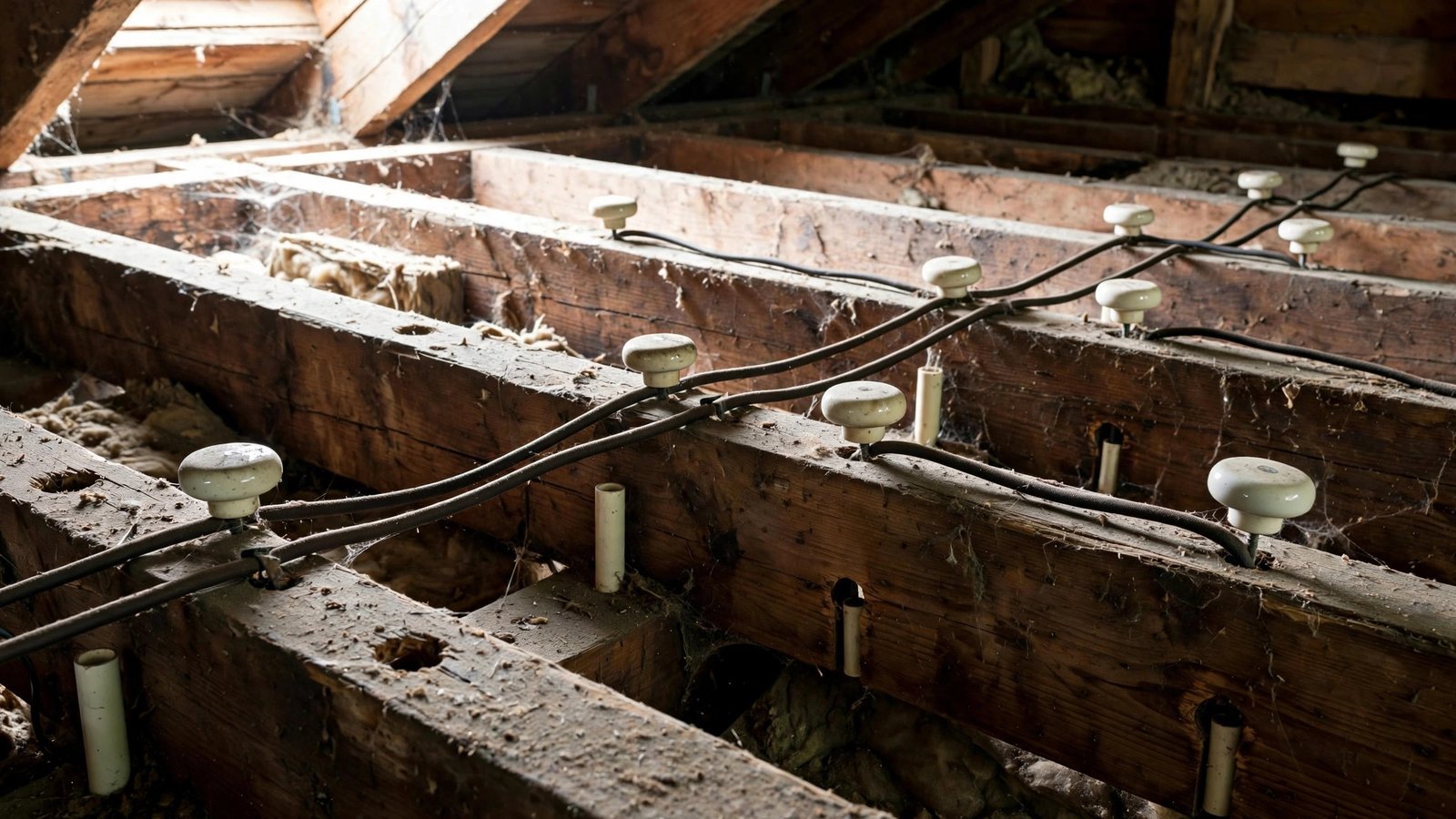
Your home inspector just handed you the report, and there it is in black and white: “knob-and-tube wiring observed in the attic.” Your stomach drops. Is the house a firetrap? Will insurance cover it? Should you walk away? Take a breath. Knob-and-tube wiring is the standard electrical system installed in American homes from roughly 1880 to the 1940s, and finding it is extremely common in older houses. It is not automatically dangerous — but it does raise real issues around safety, insurance, and cost that you need to understand before closing. Here is what to do, step by step.
What Knob-and-Tube Wiring Actually Is
Knob-and-tube (K&T) was the first widespread residential wiring method: individual copper conductors run through ceramic tubes where they pass through wood framing and supported by ceramic knobs nailed to joists, with the hot and neutral wires separated by several inches of air. There is no ground wire. When installed correctly and left undisturbed, K&T is a fundamentally sound system — the air separation dissipates heat well, and the ceramic components do not degrade. Millions of homes ran safely on it for decades. The problems come from what happened afterward: eight decades of amateur modifications, splices buried in walls, and most critically, insulation blown or laid over the wires. K&T was designed to dissipate heat into open air; burying it in insulation traps heat and creates a genuine fire risk. An inspector finding K&T is really flagging a system that needs professional evaluation, not an automatic condemnation.
Is It Dangerous? The Honest Answer
Undisturbed, properly installed K&T with no insulation contact and intact insulation on the wires is not the firetrap people imagine — but “undisturbed” is doing heavy lifting in that sentence. In practice, inspectors and electricians worry about five things: insulation covering the wires (the biggest risk), brittle or cracked wire insulation from age and heat, improper splices made over the decades without junction boxes, overloaded circuits (K&T was designed for a few light bulbs per circuit, not modern appliance loads), and the lack of grounding, which leaves you without protection for three-prong appliances and GFCI effectiveness. The Electrical Safety Foundation International’s resources on older home wiring detail these hazards. The right move is not panic but assessment: have a licensed electrician evaluate the system’s actual condition rather than treating all K&T as equal.
The Insurance Problem (Often Bigger Than the Safety Problem)
Here is where K&T hits hardest: many insurance companies will not write a new homeowner’s policy on a house with active knob-and-tube wiring, or they will charge significantly higher premiums. Insurers care about statistical risk across thousands of homes, not whether your particular K&T is pristine. This can derail a purchase entirely if you cannot secure insurance — and your mortgage lender requires it. Before you go further, call your insurance agent with the inspection report in hand and ask directly: will you insure this home, at what cost, and what remediation timeline do you require? Some insurers grant a 30-to-90-day window to replace the wiring after closing. Get this answer in writing. If insurance is unavailable or punitive, that fact alone may justify renegotiating or walking away.
Get a Licensed Electrician’s Assessment
Do not rely solely on the home inspector’s note — inspectors flag K&T but rarely evaluate it deeply. Hire a licensed electrician to inspect the system specifically and provide a written assessment: how much K&T is active versus abandoned, its condition, whether insulation contacts it, whether circuits are overloaded, and what remediation they recommend. This typically costs $200 to $400 and gives you the two things you need: a safety verdict and a cost estimate for the real negotiations ahead. Ask specifically whether the system can be made safe short-term (removing insulation contact, for example) or needs full replacement. An electrician who works on old houses regularly is worth seeking out — they see K&T weekly and give calibrated advice, unlike generalists who reflexively recommend a $20,000 rewire for every case. The old-house electrical guides at This Old House show what proper K&T assessment looks like.
What Replacement Costs and How to Negotiate It
Full replacement of K&T with modern grounded wiring typically costs $8,000 to $15,000 for an average home, varying with size, accessibility, and local labor rates — plaster walls and finished spaces push costs up since fishing wire is labor-intensive. Partial replacement (just the accessible attic and basement runs, for instance) costs less but leaves the insurance problem unsolved, since most insurers want all active K&T gone. Armed with the electrician’s written estimate, you have three negotiation paths: ask the seller to replace the wiring before closing (rare, but possible in buyer-friendly markets), ask for a closing credit or price reduction covering the replacement cost (most common), or accept the cost yourself if the home is otherwise priced accordingly. Get quotes from two electricians so your credit request rests on real numbers, not one contractor’s guess. Whatever you agree on, put the remediation timeline in the contract.
Living With K&T Temporarily: The Ground Rules
If you proceed with K&T in place short-term — say, during the insurance grace period — follow strict rules. Do not add insulation anywhere near K&T wiring; if you are insulating the attic, the K&T must be replaced or deactivated first. Do not overload the circuits: K&T circuits are typically 15-amp, so no space heaters, and be cautious with window AC units. Replace any missing or damaged knob and tube components, and have an electrician remove abandoned dead wiring, which confuses future work. Install arc-fault protection where possible and smoke detectors throughout — cheap insurance regardless. And get the replacement scheduled promptly; “temporary” K&T has a way of becoming permanent once the boxes are unpacked. For more old-house guidance, browse our home improvement guides.
If your home inspection finds knob-and-tube wiring, do not panic — but do act. Get a licensed electrician’s written assessment ($200-$400), call your insurer before going further since many will not cover active K&T, and negotiate the $8,000-$15,000 replacement cost with the seller via credit or price reduction. Never bury K&T in insulation, never overload its circuits, and schedule full replacement promptly — partial fixes rarely satisfy insurers.
Conclusion
Knob-and-tube wiring on an inspection report is a negotiation point and a project, not a dealbreaker — provided you handle it deliberately. Assess it professionally, sort out insurance early, negotiate the replacement cost with real quotes, and follow strict safety rules in the meantime. Old houses have old systems; the buyers who thrive are the ones who price the fixes before closing, not after. Buying an older home? Meet our team or send us your questions.
Frequently Asked Questions
Should I walk away from a house with knob-and-tube wiring?
Not necessarily. K&T is common in pre-1940s homes and the replacement cost is quantifiable ($8,000-$15,000 typically). Walk away only if insurance is unavailable, the seller will not negotiate on the remediation cost, or the electrical issues combine with other major problems.
Can knob-and-tube wiring be insured?
Many standard insurers decline new policies on homes with active K&T; others charge higher premiums or require replacement within 30-90 days. Specialty insurers may cover it at higher cost. Always confirm with your agent before removing inspection contingencies.
Is it legal to sell a house with knob-and-tube wiring?
Yes — K&T is typically grandfathered under code, meaning existing installations are legal even though new K&T has not been installed in decades. It must be disclosed to buyers, and it becomes a negotiation item rather than a legal violation.
Can I just replace part of the knob-and-tube?
You can, but it rarely solves the insurance problem — most insurers require all active K&T to be replaced. Partial replacement also creates complex junctions between old and new wiring that need careful professional execution. Full replacement is usually the cleaner solution.
How long does K&T replacement take?
Most whole-house replacements take 3 to 10 days depending on home size and how finished the walls are. Plaster walls slow the work since fishing wire takes longer. Your electrician should also patch the access holes or coordinate with a drywall contractor.
Leave a Reply