
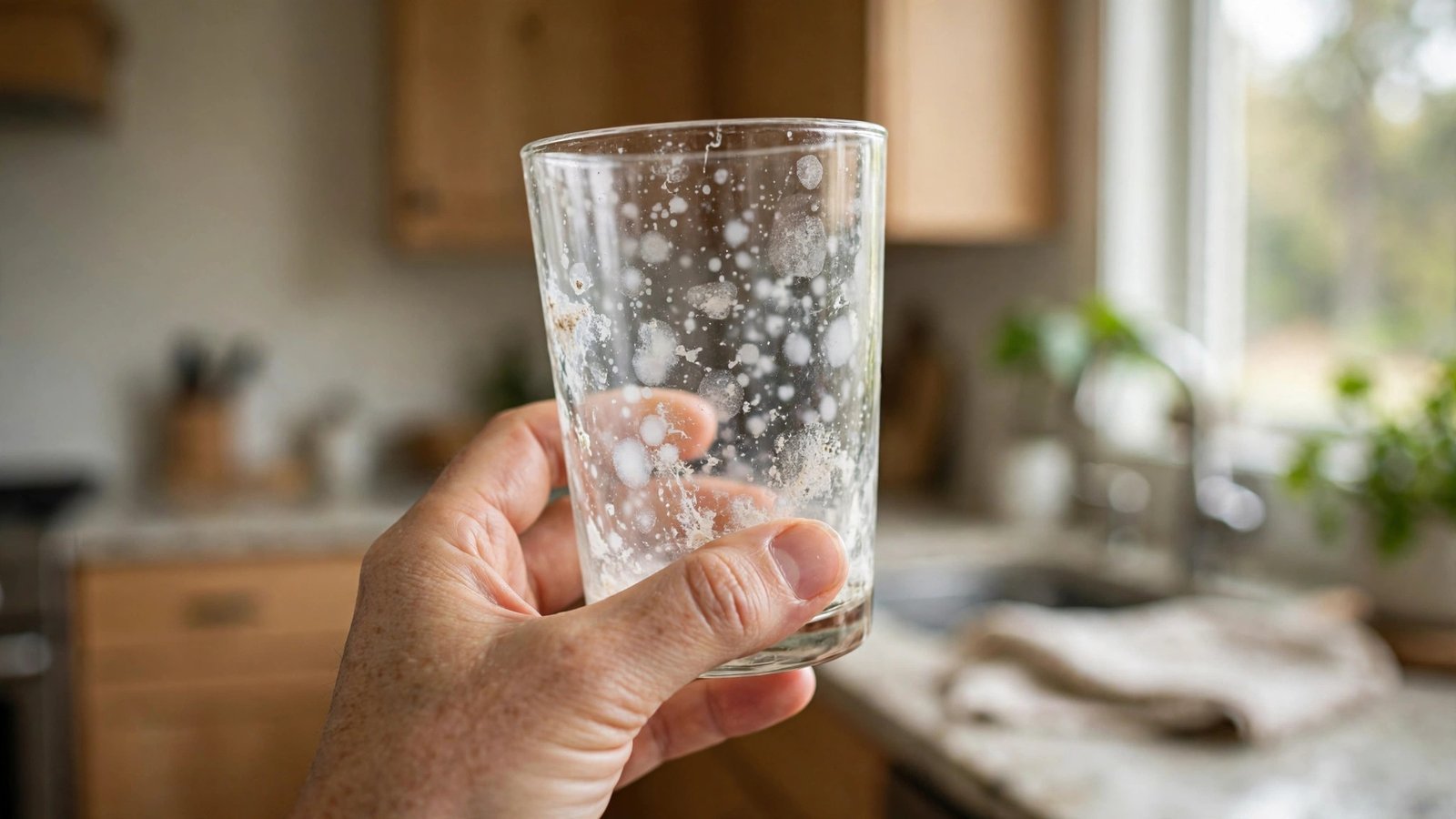
You unload the dishwasher and every glass comes out wearing a cloudy white film, like they have been dusted with chalk. White spots on glasses are one of the most common dishwasher complaints in America, and the good news is that they are almost never a sign your dishwasher is dying. In the vast majority of cases, those spots are mineral deposits left behind by hard water — and the fix is a combination of rinse aid, the right detergent dose, and hotter water. But spots can also signal detergent problems or, worse, permanent glass etching. Here is how to tell the difference and fix each cause.
Cause #1: Hard Water Minerals (The Usual Suspect)
If your home has hard water — and roughly 85 percent of American homes do to some degree — the white spots are calcium and magnesium deposits left behind when the rinse water evaporates. The test is simple: soak a spotted glass in white vinegar for 15 minutes. If the spots wipe away, it is mineral deposits, and your dishwasher is fine. Hard water spots get worse with very hot drying cycles, which bake the minerals on. The single most effective fix is rinse aid: it changes how water sheets off glassware so minerals wash away instead of drying in place. Fill the rinse aid dispenser completely and set it to a medium-high setting. If your dishwasher is older and lacks a dispenser, add rinse aid manually or switch to a detergent with built-in rinse aid. For very hard water, a whole-house water softener is the permanent answer, but rinse aid solves the symptom for pennies per load.
Cause #2: Too Much (or Too Little) Detergent
Detergent dosing is a Goldilocks problem. Too little detergent in hard water leaves minerals undealt with; too much leaves its own filmy residue that looks identical to hard water spots. Modern concentrated detergents and pods are designed for full loads in normal water — if you have soft water or run half loads, a full pod is overkill. If you use powder, measure it: the pre-wash cup plus a modest main-wash fill is plenty for most loads. Gel detergents are the worst performers against hard water spots; powder and pods generally clean better in mineral-heavy water. Never use regular dish soap in a dishwasher — it is a different chemistry entirely and will flood your kitchen with suds. The dishwashing guidance from the American Cleaning Institute explains how detergent, water temperature, and load size interact.
Cause #3: Water Not Hot Enough
Dishwasher detergent needs hot water to dissolve fully and do its job — at least 120°F at the start of the cycle. Run the kitchen faucet until the water is hot before starting the dishwasher, especially if the dishwasher is far from the water heater; otherwise the first fill is lukewarm and the detergent never fully activates. Check your water heater setting: 120°F is the recommended balance between cleaning performance and scald safety. Some dishwashers have a built-in heater with a “high-temp wash” or “sanitize” option that boosts the water temperature mid-cycle — use it if spots persist. Also avoid overloading: glasses nested too tightly block spray arms, and the glasses in the shadows come out spotty while the rest look fine. Leave space between items so water reaches every surface.
Spots vs. Etching: Know the Difference
This distinction matters because one is fixable and the other is permanent. Mineral spots sit on the surface and wipe off with vinegar. Etching is actual microscopic damage to the glass surface — it looks like a permanent rainbow-hued or cloudy film that does not respond to vinegar at all. Etching happens when soft water combines with too much detergent and too much heat over many cycles; the detergent, with no minerals to work on, starts attacking the glass itself. If your glasses are etched, no cleaning trick will restore them — prevention is the only cure. With soft water, use less detergent, skip the sanitize heat boost for everyday loads, and do not pre-rinse to the point of spotlessness; detergent needs some food soil to work on instead of your glassware. Consumer Reports’ dishwasher testing has documented how detergent formulas and water hardness interact to cause etching.
The Deep-Clean Reset for Your Dishwasher
Sometimes the dishwasher itself needs attention. Once a month, clean the filter at the bottom of the tub — trapped food particles recirculate as grimy film. Check the spray arm holes for clogs and poke them clear with a toothpick. Then run an empty cycle with two cups of white vinegar in a bowl on the top rack, or use a commercial dishwasher cleaner; this dissolves the mineral scale coating the interior, which otherwise redeposits on every load. Wipe the door gasket, where mold and residue collect. If your machine is more than ten years old and the heating element is failing, water never gets hot enough and spots become chronic — at that point, replacement beats repair. A clean machine with clear spray arms and a fresh filter washes dramatically better than a neglected one.
White spots on glasses are usually hard water minerals, not a broken dishwasher. Confirm with the vinegar test — if spots wipe away, they are minerals. Fix them with a full rinse aid dispenser, the right detergent dose for your water hardness, 120°F water, and a monthly vinegar cleaning cycle. If vinegar does nothing, the glasses are etched, which is permanent — prevent it with less detergent and less heat in soft water.
Conclusion
A dishwasher that leaves white spots on glasses is almost always a water chemistry problem, not an appliance problem. Test with vinegar, fill the rinse aid, dial in your detergent dose, make sure the water runs hot, and deep-clean the machine monthly. Your glasses will come out clear, and you will have saved yourself an unnecessary appliance purchase. For more appliance troubleshooting, check our home improvement guides, meet our team, or send us your questions.
Frequently Asked Questions
Will vinegar damage my dishwasher?
White vinegar in an empty cleaning cycle is safe for most dishwashers and excellent at dissolving mineral scale. Do not pour vinegar directly on rubber gaskets repeatedly, and skip it if your manual specifically warns against acids — a commercial dishwasher cleaner is the alternative.
How do I know if my water is hard?
White spots on dishes, scale on faucets and showerheads, and soap that does not lather well all point to hard water. Your local water utility publishes hardness data, or a $10 test strip kit from a hardware store gives you an exact grains-per-gallon reading.
Is rinse aid really necessary?
In hard water, yes — it is the single most effective anti-spot measure. Rinse aid lowers water’s surface tension so it sheets off glasses instead of beading and evaporating into mineral spots. Keep the dispenser full and adjust the setting up if spots persist.
Why are only my glasses spotted but not my plates?
Glass shows mineral film far more visibly than opaque dishes — your plates likely have the same deposits, you just cannot see them. Glasses also sit on the top rack where water pools and evaporates, concentrating minerals as they dry.
Can I prevent spots without a water softener?
Yes, in most cases: rinse aid, correct detergent dosing, hot water, not overloading, and monthly machine cleaning handle moderate hardness. A softener becomes worth it only with very hard water (above 10 grains per gallon) or when scale is damaging plumbing and appliances.
Leave a Reply