Your partner says your snoring could wake the neighbors. You are wondering: is this just loud, obnoxious snoring, or is it sleep apnea — the medical condition where breathing repeatedly stops during sleep? The distinction matters enormously. Simple snoring is a nuisance; sleep apnea is a serious disorder linked to heart disease, stroke, diabetes, high blood pressure, and daytime accidents. An estimated 30 million Americans have sleep apnea, and the large majority are undiagnosed — many of them told themselves for years that they “just snore loudly.” Here is how to tell the difference and what to do about each.
What Sleep Apnea Actually Is
Obstructive sleep apnea (OSA) — the common type — happens when the throat muscles relax during sleep enough for the airway to collapse partially or completely, blocking airflow. Each blockage (apnea) lasts 10-30+ seconds, oxygen levels drop, and the brain jolts you partially awake to resume breathing — often with a gasp or snort you do not remember. In moderate to severe apnea, this cycle repeats dozens of times per hour, all night, every night. The body never gets sustained deep sleep; the cardiovascular system endures repeated oxygen-deprivation stress; and the brain accumulates a massive sleep debt despite 8 hours in bed. Central sleep apnea (less common) involves the brain failing to signal breathing muscles, often linked to heart conditions or neurological issues. The key conceptual difference from snoring: simple snoring is noisy airflow through a narrowed airway; apnea is airflow stopping because the airway closed. One is sound; the other is suffocation, repeated all night. The National Heart, Lung, and Blood Institute’s apnea resources describe the physiology and risks authoritatively.
The Symptom Checklist: Apnea vs. Simple Snoring
Run through these honestly — ideally with your partner’s input, since you sleep through the evidence. Points toward sleep apnea: witnessed pauses in breathing (the single most specific sign — your partner notices you go quiet, then gasp); gasping, choking, or snorting awake; excessive daytime sleepiness despite adequate time in bed (falling asleep reading, in meetings, or — critically — while driving); morning headaches (from overnight oxygen deprivation and CO2 buildup); waking with a dry mouth or sore throat; difficulty concentrating, memory problems, or irritability; high blood pressure that is difficult to control with medication; and nighttime urination (apnea increases atrial natriuretic peptide, driving urine production — a lesser-known but real sign). Points toward simple snoring: loud but steady snoring without pauses; no daytime sleepiness; no morning headaches; symptoms that resolve completely with position change (side-sleeping silences it). The Epworth Sleepiness Scale (freely available online) quantifies daytime sleepiness objectively — scores above 10 suggest a problem worth evaluating. Three or more apnea signs means get tested; do not wait.
Risk Factors: Who Should Be Most Suspicious
Certain profiles should have a lower threshold for evaluation. Excess weight is the dominant risk factor — fat deposits around the neck narrow the airway, and the risk rises steeply with BMI; roughly half of people with severe obesity have sleep apnea. But thin people get it too, especially with: a thick neck circumference (over 17 inches for men, 16 for women — a better predictor than BMI alone); a recessed chin, large tongue, or large tonsils (anatomy matters); being male (2-3x the risk, though post-menopausal women catch up); age over 40 (throat muscle tone declines); family history (airway anatomy is heritable); nasal congestion or deviated septum (forcing mouth breathing); alcohol or sedative use before bed (over-relaxing throat muscles); and smoking (inflames the airway). If you check several boxes and snore loudly, the pre-test probability is high enough that evaluation is clearly worthwhile. Our health library covers more on sleep disorders and their risk factors.
How Testing Works (Easier Than You Think)
The barrier to diagnosis used to be the sleep lab — a night wired up in a strange bed. Home sleep testing has changed everything: for suspected uncomplicated obstructive apnea, your doctor can prescribe a home sleep apnea test (HSAT) — a small device with a finger oxygen sensor, nasal airflow cannula, and chest belt that you wear one night in your own bed. It measures the apnea-hypopnea index (AHI): the number of breathing interruptions per hour. Under 5 is normal; 5-15 is mild; 15-30 moderate; over 30 severe. The test is simple, usually covered by insurance with a doctor’s order, and definitive for straightforward cases. In-lab polysomnography (the full sleep study) is still used when the picture is complex — suspected central apnea, other sleep disorders, severe cardiopulmonary disease, or inconclusive home tests. Either way, the process is painless and the data is unambiguous. There is no reason to guess about apnea in the home-testing era — one night of data answers the question. Ask your primary-care doctor for a referral to a sleep specialist or a home test prescription.
Treatment: What Works for Each
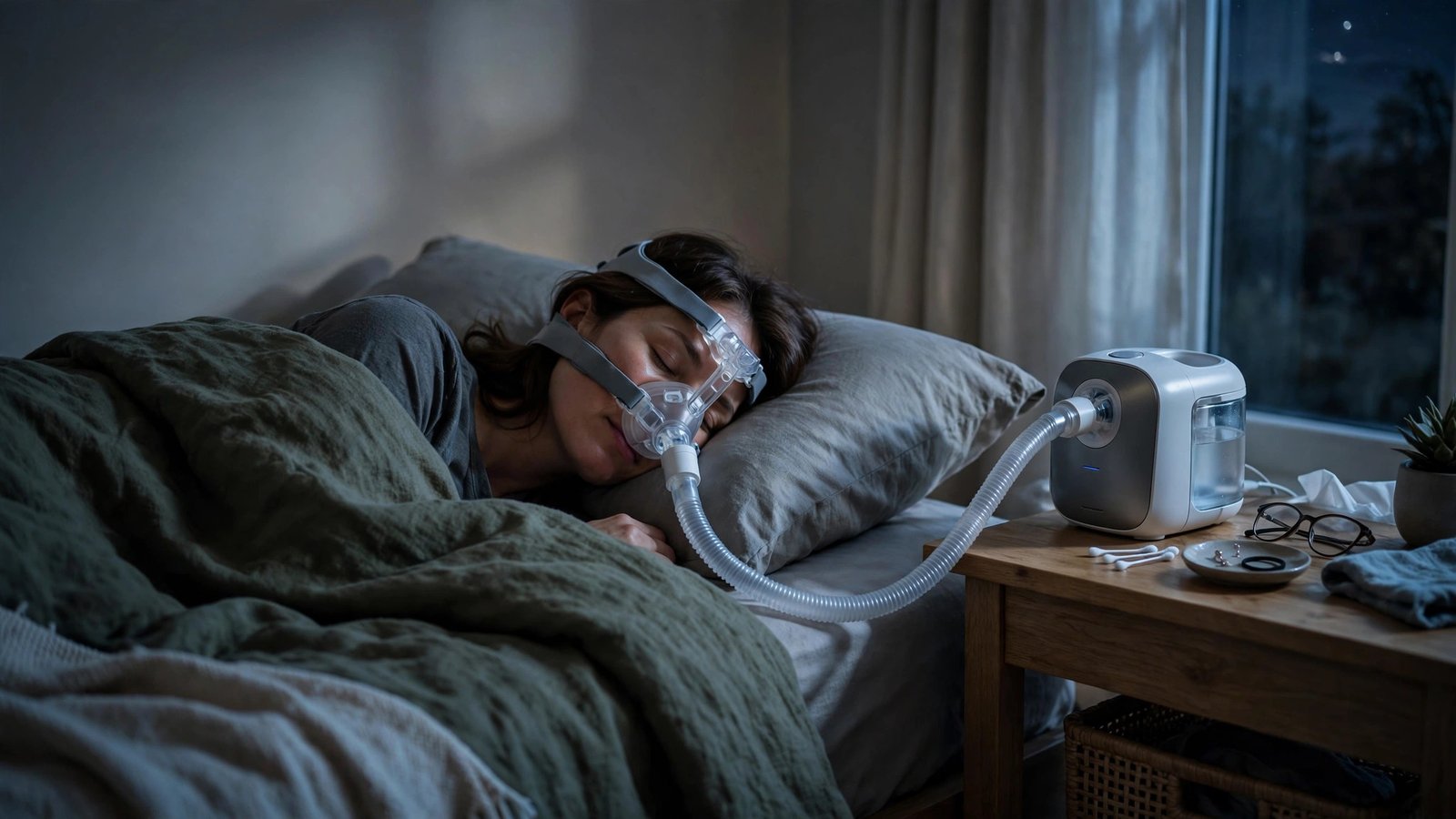
The treatments diverge completely, which is why the distinction matters. For simple snoring: positional therapy (side-sleeping), weight management, alcohol timing, nasal clearing, throat exercises, and mandibular advancement mouthpieces (OTC or custom-fitted — they hold the jaw forward, opening the airway) — our snoring guide details these. For sleep apnea, CPAP (continuous positive airway pressure) is the gold standard: a bedside machine delivering gentle air pressure through a mask, pneumatically splinting the airway open. Modern CPAPs are quiet, the masks far less intrusive than the old stereotypes, and the effect is often transformative — patients describe the first good night in years. Alternatives for those who cannot tolerate CPAP: custom mandibular advancement devices (effective for mild-moderate apnea), positional therapy devices (for position-dependent apnea), weight loss (can resolve mild cases), and surgical options (from tonsillectomy to hypoglossal nerve stimulation implants) for selected anatomies. Untreated apnea, meanwhile, is not a lifestyle choice — it roughly doubles cardiovascular risk and significantly raises accident risk. If testing confirms it, treat it. If this sounds like you or your partner, reach out — then call your doctor.
Loud steady snoring without pauses or daytime symptoms is usually simple snoring. Witnessed breathing pauses, gasping awake, crushing daytime sleepiness, morning headaches, and hard-to-control blood pressure point to sleep apnea — a serious, treatable medical condition. A one-night home sleep test gives a definitive answer; do not guess for years.
Conclusion
The snoring-versus-apnea question has a clear answer path: check the symptom list honestly (with your partner’s help), note your risk factors, and if apnea signs are present, get the home sleep test — one night, definitive data. Simple snoring gets the behavioral playbook; apnea gets medical treatment, usually CPAP, that genuinely transforms lives. The worst outcome is neither snoring nor apnea — it is undiagnosed apnea grinding away at your heart and brain for a decade because it seemed like “just snoring.” Get tested. Learn more about our evidence-based health reporting. The American Academy of Sleep Medicine accredits sleep centers and explains the testing process.
Frequently Asked Questions
Can you have sleep apnea without snoring?
Yes, though it is less common — central sleep apnea and some obstructive cases present with daytime sleepiness, morning headaches, or witnessed pauses without loud snoring. Absence of snoring does not rule out apnea if other symptoms are present.
Is a home sleep test as good as a lab study?
For uncomplicated suspected obstructive apnea, yes — home tests are validated, simpler, cheaper, and definitive. Lab studies remain necessary for complex cases: suspected central apnea, other sleep disorders, significant heart/lung disease, or inconclusive home results.
Do I have to use CPAP forever?
Apnea is typically a chronic condition, so treatment is ongoing — but “treatment” evolves. Significant weight loss can resolve mild cases; anatomical treatments (surgery, nerve stimulation) can reduce or eliminate CPAP need in selected patients. Think of CPAP as management, not necessarily a life sentence.
Can losing weight cure sleep apnea?
It can resolve mild apnea and significantly improve moderate-severe cases — weight loss is among the most effective interventions. But anatomy (jaw structure, tonsils, tongue size) also matters, so not all apnea is weight-driven; thin people with anatomical predisposition need other treatments.
Is snoring always a sign of apnea?
No — most snorers do not have apnea. But all apnea patients snore (or have snored). The distinguishing features are the pauses, gasping, and daytime consequences. Loud habitual snoring plus any apnea symptom deserves evaluation; loud steady snoring alone, without other signs, is usually simple snoring.