
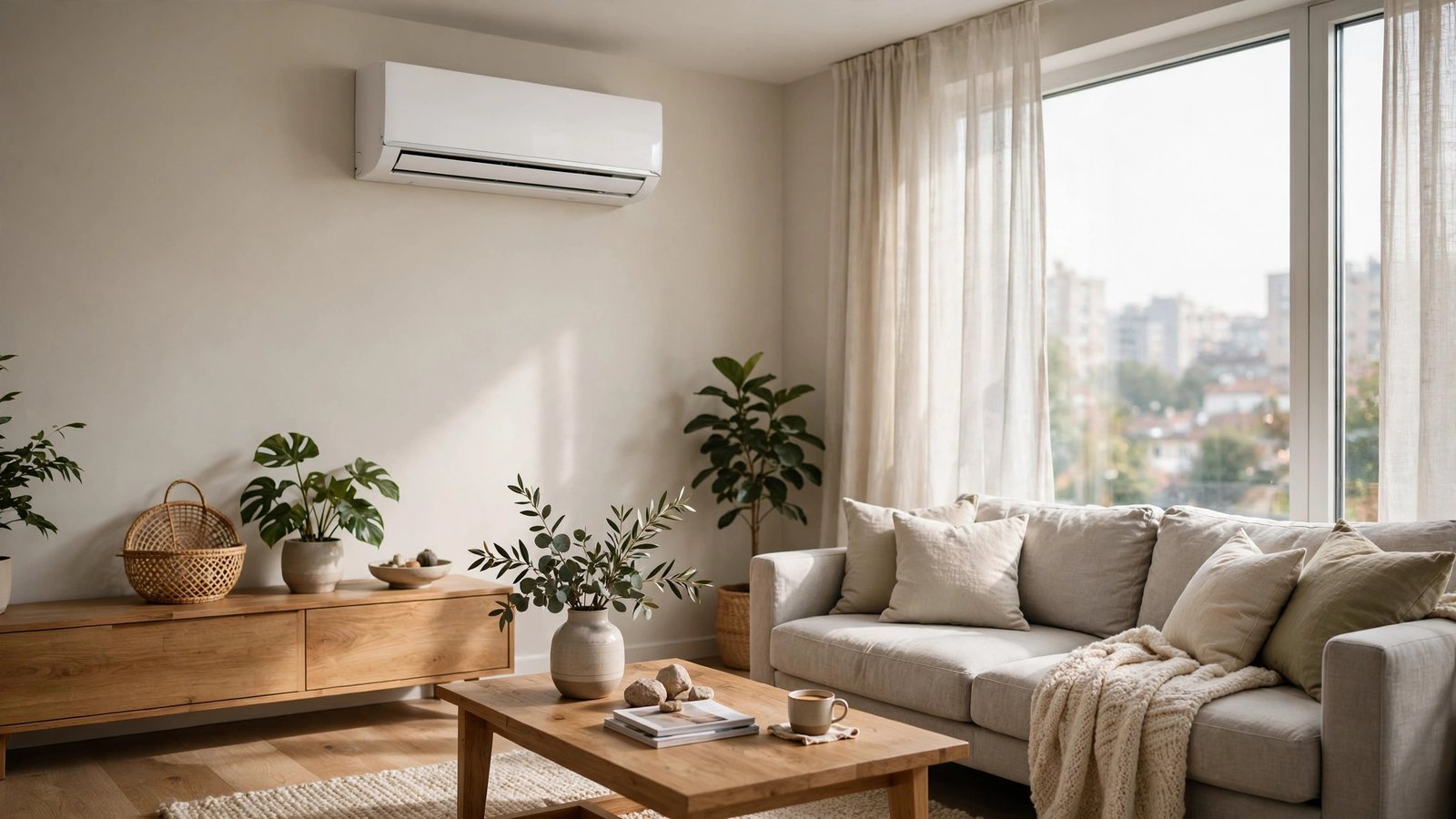
Mini splits — those sleek wall-mounted units you see in renovated apartments and additions — have become the go-to cooling solution for spaces without ductwork. For a 2-bedroom apartment, they promise efficient, room-by-room climate control without the window-unit eyesore or the central-air price tag. But “how much does it cost” is a trickier question than most installers’ ads suggest, because the total swings wildly based on how many indoor units you need, your electrical panel’s capacity, and whether your landlord allows it at all. Here is the real cost breakdown.
The Short Answer: $3,000 to $8,000 Installed
For a typical 2-bedroom apartment (800 to 1,100 square feet), a professionally installed mini-split system usually runs $3,000 to $8,000 all-in. That range covers the two most common configurations: a single-zone system (one outdoor condenser + one indoor head, $2,500 to $4,500 installed) cooling the main living area, or a multi-zone system (one condenser + two or three indoor heads, $4,500 to $8,000+) covering bedrooms individually. The equipment itself — a quality single-zone unit from Mitsubishi, Daikin, Fujitsu, or LG — costs $1,200 to $2,500; multi-zone equipment runs $2,500 to $5,000. Labor makes up the rest: $1,500 to $3,500 depending on installation complexity. Beware quotes under $2,000 for a full install — they usually mean undersized equipment, unlicensed installers, or missing electrical work that surfaces later as change orders.
What Drives the Price Up or Down
Five factors move your quote within (or beyond) that range. First, the number of zones: each additional indoor head adds $1,000 to $2,000 installed. Second, BTU sizing: a 2-bedroom apartment typically needs 18,000 to 24,000 BTU total, but poor insulation, top-floor heat, or sun-blasted windows push that higher — and oversizing wastes money while undersizing leaves you sweaty. Third, electrical work: mini splits need a dedicated 220V circuit, and if your panel is full or outdated, the electrician’s portion can add $500 to $2,000. Fourth, line-set routing: the refrigerant lines connecting indoor and outdoor units are cheapest when the path is short and simple; long runs through finished walls cost more. Fifth, your climate: in regions with real winters, a cold-climate heat-pump model (which also heats efficiently) costs 15 to 25 percent more but can replace baseboard heating. The ENERGY STAR ductless heating and cooling guide explains efficiency ratings (SEER2/HSPF2) so you can compare models apples-to-apples.
The Renter Problem: Landlord Permission
Here is the issue apartment-specific guides often bury: if you rent, you almost certainly need written landlord approval, and many landlords say no. Mini-split installation involves drilling through exterior walls, mounting a condenser (on a balcony, roof, or ground pad), and running a dedicated electrical circuit — all modifications to someone else’s building. Some landlords approve it (especially if you pay and it improves their property), some allow only portable or window units, and some prohibit exterior modifications entirely in the lease. Before getting quotes, read your lease and ask in writing. If you own a condo, check the HOA rules — many restrict condenser placement, noise levels, and exterior penetrations. For renters who get a “no,” the fallback options are high-efficiency window units ($300 to $600, no permission needed in most leases) or portable units (least efficient, but truly plug-and-play).
DIY vs. Professional Installation
You will see “DIY mini split” kits online for $1,000 to $1,800 with pre-charged line sets marketed as homeowner-installable. The honest assessment: mechanically inclined homeowners do install these successfully, but there are real catches. Most US jurisdictions require permits and licensed electricians for the 220V circuit regardless of who mounts the units. The warranty situation is brutal — most major manufacturers void or limit warranties on DIY-installed units, and some will not sell parts to unlicensed installers. Improper vacuuming of the line set (skipped by many DIYers) causes moisture contamination that kills compressors within a few years. And refrigerant handling is federally regulated — venting refrigerant carries EPA fines. For a 2-bedroom apartment, where the install is relatively simple, a licensed installer charging $1,500 to $2,500 in labor buys you a valid warranty, correct sizing, permit compliance, and someone to call when it breaks. The Department of Energy’s ductless mini-split overview is worth reading before you decide which path to take.
Operating Costs and Payback
The install price is only half the economics. Mini splits are dramatically more efficient than window units — SEER2 ratings of 18 to 25 versus 11 to 12 for typical window ACs — which translates to 30 to 50 percent lower cooling bills for the same space. For a 2-bedroom apartment, expect $30 to $60 per month in cooling-season electricity for a properly sized mini split, versus $60 to $120 for equivalent window units. If the system also handles heating (heat-pump models), winter savings against electric baseboard heat can be even larger — heat pumps deliver 2 to 3 times more heat per dollar than resistance heating. Many utilities and states offer rebates for high-efficiency mini splits ($300 to $1,000+); check the DSIRE database for your area. At typical savings, the premium over window units pays back in 3 to 6 years — faster if you are replacing electric heat.
A mini split for a 2-bedroom apartment costs $3,000 to $8,000 professionally installed — $2,500–$4,500 for single-zone, $4,500–$8,000+ for multi-zone. Renters need written landlord approval first. The efficiency payoff is real: 30–50% lower cooling bills than window units, with payback typically in 3–6 years.
Conclusion
Installing a mini split in a 2-bedroom apartment is a $3,000 to $8,000 investment that buys whisper-quiet, room-by-room comfort at roughly half the operating cost of window units. Get multiple licensed quotes, verify your electrical panel can handle the load, secure landlord or HOA approval in writing before spending a dollar, and check for utility rebates. Sized right and installed professionally, it is one of the highest-satisfaction upgrades an apartment can get. For more home comfort guides, browse our home improvement section, learn about our team, or ask us your questions.
Frequently Asked Questions
How many BTUs do I need for a 2-bedroom apartment?
Typically 18,000 to 24,000 BTU total for 800–1,100 square feet, but insulation quality, ceiling height, sun exposure, and floor level all matter. Have an installer do a proper load calculation (Manual J) rather than guessing — both oversizing and undersizing cause problems.
Can I install a mini split in a rental apartment?
Only with written landlord approval — installation requires drilling through exterior walls, mounting an outdoor condenser, and adding a dedicated 220V circuit. Many leases prohibit such modifications. Ask before getting quotes, and get any approval in writing.
Is a DIY mini split kit worth it?
The kits ($1,000–$1,800) can work for skilled DIYers, but most manufacturers limit warranties on self-installed units, you still need a licensed electrician for the 220V circuit and permits, and improper line-set vacuuming destroys compressors. Professional installation ($1,500–$2,500 labor) buys warranty protection and code compliance.
How much does a mini split cost to run per month?
For a 2-bedroom apartment, roughly $30–$60/month during cooling season for a properly sized efficient unit — 30–50% less than equivalent window ACs. Heat-pump models heating in winter can save even more versus electric baseboard heat.
Do mini splits work in cold climates?
Cold-climate models (rated to -13°F or lower) heat efficiently well below freezing, though efficiency drops as temperatures fall. Standard models lose heating capacity around 30–40°F. If you want heating too, specify a cold-climate heat-pump model — it costs 15–25% more but replaces baseboard heating.
Leave a Reply