
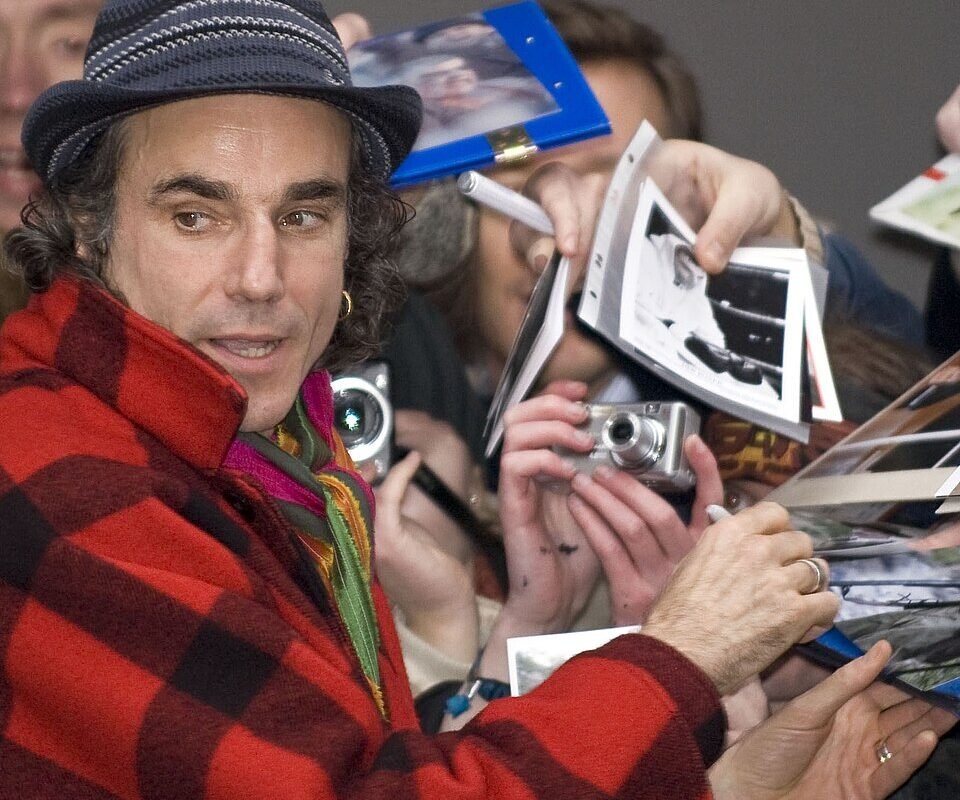
Daniel Day-Lewis at 69: Three Oscars and a $40 Million Record
First, the Figure
Celebrity Net Worth estimates Daniel Day-Lewis’s fortune at $40 million, and this report adopts that figure with its source attached. Day-Lewis built the money in an unusual way: he made very few productions across four decades, charged top fees for the ones he accepted, and spent long stretches away from acting entirely, including years as an apprentice shoemaker in Florence and an eight-year retirement that ended only in 2025. Selectivity, not volume, produced both the reputation and the balance.
Trackers outside the named sources run higher, at $50 million to $60 million, and this report records that range without adopting it. No Forbes list and no Sunday Times Rich List entry gives him a personal wealth total. His fees per production rarely reach print with any documentation, so counters work from box office history, award standing and the known economics of his directors’ productions. Readers should hold the $40 million as the named tracker’s estimate and the higher range as unverified background, exactly as the record below presents them.
His present-day position adds a late chapter to the count. Day-Lewis returned to the screen in Anemone, which premiered at the New York Film Festival in 2025 and reached audiences that October. He co-wrote the production with his son Ronan Day-Lewis, who directed it. In a September 2025 interview with Rolling Stone, he said he never truly intended to retire and called his 2017 remarks grandiose. At 69, he stands as the only male actor holding three Academy Awards for Best Actor, and he holds a knighthood for services to drama, conferred in 2014.
The Rise, Year by Year
1985 — My Beautiful Laundrette and A Room with a View
Two productions in one year announced him. My Beautiful Laundrette cast him as a street punk in a London drama, and A Room with a View placed him in a Merchant Ivory period piece the same season. Critics cited the contrast for years afterward as proof of range, and casting directors on both sides of the Atlantic began building projects around him.
1988 — The Unbearable Lightness of Being
Philip Kaufman cast him as a Prague surgeon in The Unbearable Lightness of Being, and Day-Lewis learned Czech-accented delivery and medical procedure for the part. The production began the public record of his preparation method: he stays in character through a shoot and acquires the skills his characters hold.
1989 — My Left Foot
My Left Foot cast him as Christy Brown, the Irish writer and painter who lived with cerebral palsy, and the performance won him his first Academy Award for Best Actor. He remained in a wheelchair through the production day, and crew members fed him at breaks so the immersion never broke. The Oscar fixed his standing at 32.
1992 — The Last of the Mohicans
Michael Mann’s The Last of the Mohicans cast him as Hawkeye and turned him, briefly, into an action lead. He trained in wilderness skills and period weaponry for months before cameras rolled. The production earned strongly and remains his most purely commercial success of the 1990s.
1993 — In the Name of the Father and The Age of Innocence
Jim Sheridan’s In the Name of the Father cast him as Gerry Conlon, a man wrongly convicted, and Martin Scorsese’s The Age of Innocence cast him as a restrained New York lawyer the same year. Two major directors, two opposite registers, one calendar year: the pairing defined his decade.
1996 — The Crucible
The Crucible adapted Arthur Miller’s play and cast Day-Lewis as John Proctor. On that production he met Rebecca Miller, the playwright’s daughter, and the two married later that year. The credit matters in his private record as much as in his career record.
1997 — The Boxer and the Florence Years
The Boxer reunited him with Sheridan, and then Day-Lewis stepped away. He moved to Florence, Italy, and apprenticed as a shoemaker from 1997 to 2000, declining scripts and interviews. The break lasted until Scorsese offered him a role he could not refuse, and the shoemaking years became the central anecdote of his legend: a star at his peak chose a workbench over a set.
2002 — Gangs of New York
Scorsese cast him as Bill the Butcher in Gangs of New York, opposite Leonardo DiCaprio, and readers tracing that production should read Leonardo DiCaprio’s net worth profile, because the two performances anchor the picture and the two careers define their generation’s opposite poles, volume against selectivity. Day-Lewis won a BAFTA for the role and earned another Oscar nomination.
2005 — The Ballad of Jack and Rose
Rebecca Miller wrote and directed The Ballad of Jack and Rose, and Day-Lewis played its lead, a father raising his daughter in an isolated former commune. The production sits at the center of his family record as well as his career record: husband and wife built it together, and critics treated his performance as one of his most exposed. It earned little money and considerable respect, a trade his whole career accepts.
2007 — There Will Be Blood
Paul Thomas Anderson built There Will Be Blood around him, and his Daniel Plainview won a second Academy Award for Best Actor. Critics’ polls now rank the performance among the greatest in cinema history, and the production’s modest cost against its prestige return made it one of the most efficient star vehicles ever mounted.
2009 — Nine
Nine cast him as a director in a musical ensemble, a rare misstep in the record; the production underperformed and Day-Lewis returned to his pattern of long gaps between roles. He took three years before his next screen appearance.
2012 — Lincoln
Steven Spielberg’s Lincoln gave him his third Academy Award for Best Actor, a record no other male actor matches. He studied Lincoln’s voice, gait and correspondence for a year and addressed colleagues in character through the shoot. The win completed a trio across three decades: 1989, 2007, 2012.
His preparation method deserves its own paragraph, because it shapes both the fees and the gaps. Day-Lewis researches a role for months or a year, learns its trades, and holds the character’s voice and posture through the entire shoot, on camera and off. Directors accept the cost because the results anchor their productions; producers accept the schedule because his name finances serious drama. The method also limits him to one production at a time and exhausts him in ways he has described candidly, which explains the long rests between credits and, in turn, the modest production count behind the $40 million estimate.
2017 — Phantom Thread and the Announcement
Phantom Thread reunited him with Anderson and earned him another Oscar nomination. In June 2017, before its release, his spokesperson announced that he would no longer work as an actor. The statement thanked his collaborators and audiences and gave no detailed reason, and Day-Lewis largely vanished from public life afterward.
2025 — Anemone
Anemone ended the retirement. His son Ronan directed the production from a script the two wrote together, and it premiered at the New York Film Festival in 2025 before an October release. Day-Lewis plays a man confronting his past, in a family drama about fathers and sons. His Rolling Stone interview that September reframed the whole episode: he said the 2017 remarks overstated a wish for a quieter life, and he accepted the ribbing that followed his return with good humor.
The career totals defy the usual arithmetic. Fewer than two dozen leading roles produced three Oscars, four BAFTAs and a knighthood, and the scarcity raised his fee each time he returned. Celebrity Net Worth folds that record into its $40 million estimate; the higher outside range assumes the same scarcity carried a higher price.
The knighthood arrived in 2014, between Lincoln and Phantom Thread, and Buckingham Palace conferred it for services to drama. Day-Lewis accepted the honor and then returned to his pattern of privacy in Ireland, granting almost no interviews across the following decade. That silence forms part of the financial picture too: he runs no production company of consequence, endorses nothing, and licenses nothing, so the tracker’s estimate rests almost entirely on acting fees and property rather than on the brand income that lifts many peers’ totals.
Beginnings
Records list his birth as 29 April 1957 in Kensington, London. Some secondary sources misplace the birth in Greenwich; Greenwich is where the family lived and where he grew up, and this report corrects the record here. His father, Cecil Day-Lewis, held the post of Poet Laureate and wrote poetry and detective fiction. His mother, Jill Balcon, acted on stage and screen and descended from a major cinema family: her father, Michael Balcon, ran Ealing Studios during its classic period.
Day-Lewis attended Sevenoaks School in Kent and later Bedales, then trained at the Bristol Old Vic Theatre School. He joined the Royal Shakespeare Company after graduation and divided the early 1980s between stage and screen work. His father died in 1972, when Daniel turned fifteen, and biographers connect the loss to the intensity he later brought to father-son material, a connection Anemone makes literal.
The Private Side
Day-Lewis married Rebecca Miller on 13 November 1996, and the marriage continues. Miller writes novels and directs productions of her own, and the couple divide their time between Ireland, where they keep a home in County Wicklow, and New York. He took Irish citizenship in 1993, so he holds dual British and Irish citizenship, a fact the record below states directly.
The couple share two sons: Ronan Cal Day-Lewis, born 14 June 1998, and Cashel Blake Day-Lewis, born in May 2002. His eldest son, Gabriel-Kane Day-Lewis, arrived on 9 April 1995, during his earlier relationship with French actor Isabelle Adjani. Ronan’s directing debut, Anemone, turned the family into collaborators in 2025, and Day-Lewis has said the chance to work with his son drew him back more than any script could have. He keeps no verified personal Instagram account, and no handle appears in this report.
The Reporting Record
| The Reporting Record | Details |
|---|---|
| Born | 29 April 1957, Kensington, London |
| Age | 69 |
| Height | 6 ft 1 in (1.86 m) |
| Weight | No reliable published figure exists |
| Net Worth | $40 million (Celebrity Net Worth) |
| Wife | Rebecca Miller, married 13 November 1996 |
| Children | Gabriel-Kane (b. 9 April 1995), Ronan Cal (b. 14 June 1998) and Cashel Blake (b. May 2002) |
| Parents | Cecil Day-Lewis (d. 1972) and Jill Balcon (d. 2002) |
| Movies and TV Shows | My Beautiful Laundrette, My Left Foot, The Last of the Mohicans, In the Name of the Father, Gangs of New York, There Will Be Blood, Lincoln, Phantom Thread, Anemone |
| Nationality | British and Irish (dual citizenship; Irish citizenship taken in 1993) |
| No verified personal account |
What It All Adds Up To
Celebrity Net Worth credits Day-Lewis with $40 million, outside trackers suggest $50 million to $60 million, and the disagreement suits a man who never published a number of his own. The fortune rests on a small count of productions, each one an event, and on fees that scarcity kept at the top of the market for thirty years.
At 69, he holds a record no peer matches and a career he twice walked away from and twice resumed on his own terms. Anemone adds a father-son collaboration to the record, and the reporting position closes where it started: a selective actor, a modest fortune by franchise standards, and a reputation that money measures badly.
Filed under: Net Worth