Phil Collins at $350 Million: The Drummer Who Sang His Way to a Fortune
First, the Figure
Celebrity Net Worth puts Phil Collins’s net worth at $350 million, and the tracker held that line again on a fresh read in November 2026. The figure rests on one of the deepest catalogs in pop: a decade of Genesis albums, a solo run that dominated 1980s radio, songwriting royalties that still pay out every quarter, and a catalog transaction that converted part of that work into capital. Collins himself has never published a personal balance sheet, so the $350 million stands as a named tracker’s estimate, and this profile prints it as exactly that.
Two other numbers circulate near his name, and neither one counts as net worth. Forbes counted $45 million in earnings for a single year in its 2020 coverage, a salary-and-touring snapshot rather than a wealth total. In September 2022, Concord acquired the music works and recordings of Collins, Tony Banks and Mike Rutherford in a joint transaction that trade reports priced around $300 million; that price covers three men’s Genesis and solo catalogs together, and nobody has published Collins’s individual share. This profile labels the Concord price a joint catalog transaction wherever it appears and adds none of it to the headline figure.
Collins, 75, lives in Switzerland and no longer tours. Health problems ended his drumming years ago, and nerve damage took the sticks out of his hands long before the final Genesis concerts. He still writes, still gives interviews, and in November 2026 he walked into the Rock & Roll Hall of Fame as a solo inductee, an honor that put a formal cap on a sixty-year career. The fortune, meanwhile, runs on catalog: streaming, licensing and publishing checks that arrive whether he performs or not.
The House Record
Property reporting gives two clear Collins data points. He bought a Miami Beach waterfront home in 2015 at a reported $33 million and sold it in 2021 at a reported $40 million, a transaction the real-estate press covered in detail at both ends. His principal home sits in Switzerland, in the Lake Geneva area, and he has lived there for many years. No publication has produced a verified inventory of his current holdings, and this profile claims no combined property total.
The Rise, Year by Year
1970 — The Genesis Drum Chair
Collins answered a Melody Maker advertisement and won the drummer’s job in Genesis, a young progressive rock band building a cult following on the college circuit. He drummed and sang backing vocals through five studio albums while Peter Gabriel fronted the group in elaborate stage costumes. The band toured relentlessly, recorded constantly, and built the musicianship that later paid for everything else.
1975 — The Singer Steps Forward
Gabriel left Genesis in 1975, and the band auditioned replacement singers without finding one it liked. Collins stepped up to the microphone himself, and A Trick of the Tail (1976) proved the group could thrive without its original frontman. …And Then There Were Three… followed in 1978 and delivered “Follow You Follow Me,” the band’s first major hit single, with Collins’s voice now firmly at the center of the sound.
1981 — Face Value
Collins launched his solo career with Face Value in 1981, and “In the Air Tonight” announced it with a drum break that producers still sample and advertisers still license. The album topped charts on both sides of the Atlantic. Hello, I Must Be Going! arrived in 1982 and kept the run going, and Collins suddenly carried two full careers at once, alternating Genesis albums with solo records through the decade.
1985 — No Jacket Required and the Live Aid Sprint
No Jacket Required (1985) turned Collins into the defining pop voice of the decade, with “Sussudio” and “One More Night” both reaching number one in the United States. That July he played one of the most famous days in live music: he performed his own set at Wembley during Live Aid, joined Sting on stage in the same stadium — readers can follow Sting’s net worth profile for the other half of that afternoon — then boarded the Concorde, crossed the Atlantic and played Philadelphia the same evening, drumming behind Eric Clapton and sitting in with the reunited Led Zeppelin.
1986 — Invisible Touch
Genesis released Invisible Touch in 1986, and the album outsold everything the band had done before, with the title track giving the group its only American number-one single. Collins now fronted the biggest rock band in the world while his solo records sold in parallel. Few performers have ever held both positions at once, and the combined royalties from that period still anchor his publishing income today.
1989 — …But Seriously
…But Seriously (1989) shifted his solo writing toward social subjects, and “Another Day in Paradise” became the biggest single of his career and won the Grammy for Record of the Year. Collins toured the album around the world through 1990. The record confirmed that his solo draw matched the band’s, a fact that mattered greatly when the two careers later pulled in different directions.
1993 — Both Sides and the Genesis Exit
Both Sides (1993) found Collins writing, playing and producing nearly everything himself, a deliberately spare record after a decade of gloss. He left Genesis in 1996 to concentrate on solo work and big-band jazz projects, closing a twenty-six-year chapter. Dance into the Light followed that same year, and Testify arrived in 2002 as his last album of original material for a long stretch.
1999 — Tarzan and an Oscar
Disney hired Collins to write and sing the songs for its animated adventure Tarzan, and “You’ll Be in My Heart” won him the Academy Award for Best Original Song along with a Golden Globe and a Grammy. The soundtrack introduced his voice to a generation that had never bought a Genesis record, and the song remains one of the most licensed pieces in his catalog.
2007 — The Reunion and the Injury
Genesis reunited for the Turn It On Again tour in 2007, and Collins played drums through the early dates before a spinal injury damaged vertebrae in his neck and nerves in his hands. Surgeons operated, and Collins announced that he could no longer hold drumsticks with proper grip. He returned with Going Back (2010), an album of Motown and soul covers that he sang without drumming a note.
2021 — The Last Domino
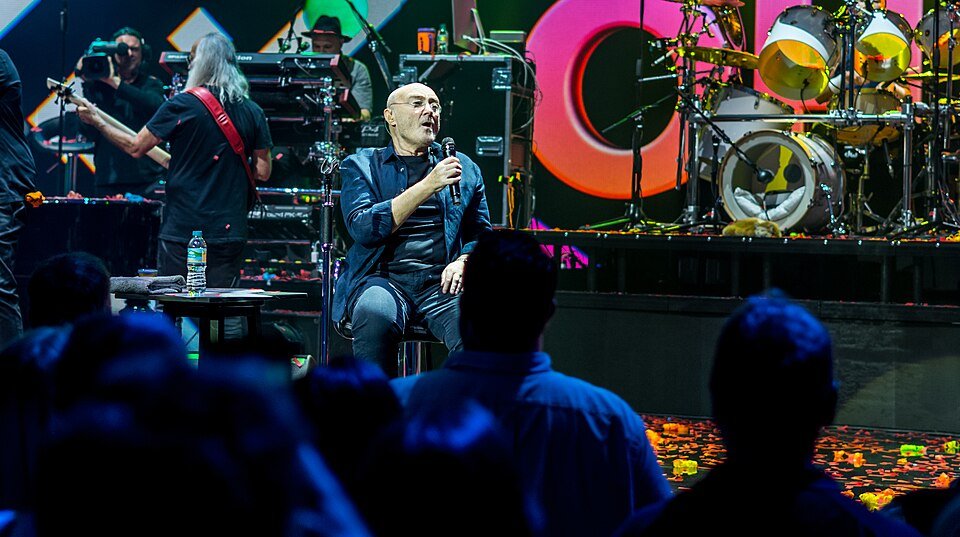
Genesis reformed once more for The Last Domino? tour, with Collins singing from a chair and his son Nicholas drumming behind him. The tour closed in London in March 2022, and Collins told the final audience that the night marked the band’s last show. He has held to that word. His health record since then includes five knee operations, a drop-foot problem that requires a cane, and an April 2024 hospital stay that he later connected to his drinking in an August 2026 Sunday Times interview; he told the paper he now lives sober, and he told the BBC in January 2026 that a live-in nurse supports his care around the clock.
2026 — The Hall of Fame
The Rock & Roll Hall of Fame inducted Collins as a solo artist on 14 November 2026, and he attended in person with his family, walking with two canes and skipping any performance. The induction honored the solo catalog specifically, separate from his earlier induction with Genesis. For a man who started as the drummer at the back of the stage, the evening completed an unusual double: hall-of-fame recognition for both the band and the solo career.
Beginnings
Philip David Charles Collins arrived on 30 January 1951 in Chiswick, London. His father, Greville Philip Austin Collins, sold insurance, and his mother, Winifred June Collins, worked as a booking agent for young performers, a job that put stage work within the family’s reach early. A toy drum kit arrived one Christmas when he was five, and real kits followed; Collins taught himself by playing along to records and radio broadcasts.
He attended stage school and took stage roles as a boy, including a West End production of Oliver!, and he learned the practical side of performing long before Genesis existed. Music won out over acting by his late teens. He drummed in a string of local bands, recorded with the group Flaming Youth in 1969, and kept answering advertisements until the Genesis audition changed the direction of his life in the summer of 1970.
The Private Side
Collins has married three times, and the record carries no confirmed current partner. He married Andrea Bertorelli in 1975, and that marriage ended in 1980; he adopted her daughter Joely during the marriage, and their son Simon arrived in 1976 and later built his own career as a drummer and singer. Collins married Jill Tavelman in 1984; their daughter Lily arrived in 1989 and grew into a prominent acting career of her own, and the marriage ended in 1996. He married Orianne Cevey in 1999, and their sons Nicholas (2001) and Matthew (2004) followed; that marriage ended in a divorce settlement in 2008, the couple reconciled in 2016, and the relationship finally ended in 2020. A long relationship with Dana Tyler ran from about 2007 to 2016. Reports sometimes attach his assistant Lindsay Evans to him in a personal capacity; the verified record credits Evans as his assistant only, and this profile upgrades nothing beyond that.
His five children span both careers and three marriages, and two of them work in music directly: Simon records and performs, and Nicholas drummed for Genesis through the final tour after years of playing in his father’s solo band. Collins speaks about his health with unusual candor for a star of his era, and his family stood beside him at the Hall of Fame induction in November 2026. His father died in 1972, just as Genesis began to climb, and his mother died in 2011.
The Reporting Record
| The Reporting Record | Details |
|---|---|
| Born | 30 January 1951, Chiswick, London (Philip David Charles Collins) |
| Age | 75 |
| Height | 5 ft 6 in |
| Weight | No reliable published figure exists |
| Net Worth | $350 million (Celebrity Net Worth) |
| Partner | No confirmed current partner |
| Children | Five: Joely (adopted), Simon, Lily, Nicholas and Matthew |
| Parents | Greville Philip Austin Collins (died 1972) and Winifred June Collins, née Strange (died 2011) |
| Family | Parents Greville and Winifred; five children; three marriages, all ended |
| Songs | “In the Air Tonight,” “Against All Odds,” “Sussudio,” “One More Night,” “Another Day in Paradise,” “You’ll Be in My Heart” |
| Albums | Face Value (1981), No Jacket Required (1985), …But Seriously (1989), Both Sides (1993), Going Back (2010) |
| House | Principal home in Switzerland (Lake Geneva area); Miami Beach home bought 2015 (reported $33 million) and sold 2021 (reported $40 million) |
| @officialphilcollins |
What It All Adds Up To
The $350 million estimate describes a catalog more than a career at this point. Collins no longer performs, his drumming days ended nearly two decades ago, and yet the publishing, the Genesis masters interest he held into the Concord transaction, and the solo hits keep generating the kind of income that sustains a top-tier tracker figure. The disagreements around his money involve side numbers — a single Forbes earnings year, a three-man catalog price — and none of them displaces the headline estimate.
At 75, Collins occupies a settled place in the record books: one of the best-selling artists in history across two distinct acts, a drummer who became a frontman almost by accident, and a songwriter whose most famous four minutes still open with a drum sound engineers study. The Hall of Fame solo induction in November 2026 simply formalized what the sales figures said decades ago.
Filed under: Net Worth